
Sports recovery massage in Newport Beach: what it does and when to book it
Running the Back Bay loop, paddling out before work, riding the peninsula — the training is the easy part. Here is what massage actually contributes to recovery, and when in the week to put it.
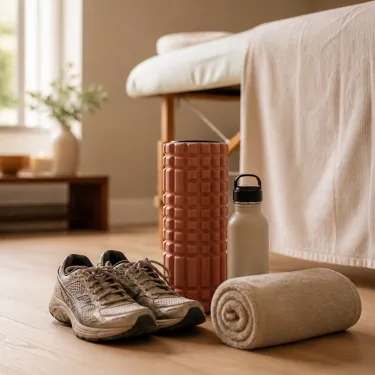
Sports recovery massage in Newport Beach mostly gets booked for the wrong reason: something already hurts, and the appointment is an attempt to undo a fortnight of ignoring it. It works better as maintenance than as repair — a standing hour that keeps the tight things from becoming the injured things. This is what it actually contributes, what it does not, and where in a training week it belongs.
What it does, honestly
Massage does three things reliably for a body in training. It restores range of motion in joints that training has quietly closed. It makes tissue that has gone hard and guarded workable again, so the next session is not fighting last week's. And it drops a keyed-up nervous system down a gear, which is the half of recovery that most people skip entirely.
What it does not do is repair torn tissue, and it does not undo a training error. If your hamstring is sharply painful, if a joint is swollen and hot, if something gave way audibly — that is a doctor, not a massage table, and no amount of pressure substitutes for a diagnosis. The most useful thing a therapist can tell you in that situation is to go somewhere else first.
The session that suits recovery best
Most people book deep tissue and assume harder is better. For recovery specifically, the better default is massage and assisted stretching together, because the limiting factor in a trained body is usually range rather than knots.
The 60-min Stretching & Swedish Massage is $130 and is built exactly this way: rhythmic Swedish strokes with warm oil first, because stretching a cold guarding muscle achieves very little, then assisted stretching of the joints your week keeps closing — hips, hamstrings, chest and shoulders — held for you rather than by you, with short Swedish passes between so the muscle is left long rather than startled. The 90-minute version is $195 when you want the whole chain rather than the two worst links.
That last detail is the one people underrate. A stretch you hold yourself lasts as long as your patience does. Being held in the position by someone else, breathing into it instead of bracing against it, is a different exercise entirely.
When deep tissue is the right call instead
When you can point at it. A calf that has been a rock since Sunday, a shoulder that only complains on the third mile, an IT band that has opinions — a named spot wants concentrated slow pressure and a cream that grips instead of glides.
The 60-min Deep Tissue Massage is $130 and an hour goes to the area you name at the start. Deep tissue massage explained covers the pressure question properly, including the part athletes most often get wrong: gritting your teeth through it is not the goal, and pressure you cannot breathe evenly through has stopped being productive.
If the tightness is more general — hips that will not open, a back that has stiffened around a bike position — Thai massage does the range-of-motion job while you stay fully clothed, which is convenient when you are going straight back out. Thai massage vs deep tissue compares the two directly.
The other reason to book maintenance rather than repair: an appointment made while nothing hurts can be spent wherever it is most useful. An appointment made because something hurts spends the hour on that one place, and the rest of the pattern that produced it goes untouched for another month.
Where to put it in the week
Not the day before a race or a hard effort. Deep work can leave you mildly sore for a day, which is fine on a Tuesday and irritating on the start line. If you want something the day before, keep it light and short.
The day after a hard effort is good, two days after is often better. Immediately after a maximal session everything is inflamed and tender; give it a day and firm work is both more comfortable and more useful.
Mid-week, in a heavy block, is the most valuable slot of all — the session nobody books, because nothing hurts yet. That is precisely why it works.
In taper week, go longer and lighter. The job that week is not tissue work, it is sleep and settling. A 90-minute Swedish does more for a taper than an hour of elbows.
Which raises the question of length rather than treatment — 60, 90 or 120 minutes decides how much of you gets attention, and a taper week is the clearest case for the longer end.
Feet, if you run or stand all day
Runners tend to treat feet as the thing that carries them to the interesting muscles. An hour spent entirely on the feet and lower legs — soles, heels and toes in a set sequence, then up into the calves and ankles — is a genuinely different experience, and the calves are usually where the surprise is.
If running is your sport specifically, massage for runners lists the five places runners are reliably tight and when in a training week to book each one.
The 60-min Foot Massage & Reflexology is $120. What reflexology is is clear about which claims stand up and which do not, which matters more here than usual — there is a lot of nonsense written about feet.
The Newport Beach version of this problem
The pattern here is specific enough to be worth naming. People who train in Orange County are rarely training only — they run the Back Bay loop before an eight-hour workday, then sit. Paddle out at dawn, then sit. Ride the peninsula on Saturday, then spend Monday to Friday at a desk.
So the hips are tight from riding and from sitting, and the shoulders are loaded from paddling and from a laptop. Treating only the athletic half means the desk half quietly undoes the work between sessions — which is why massage for desk workers and the lower-back-from-sitting problem are worth reading even if you consider yourself an athlete rather than an office worker. Most people here are both.
By sport, briefly
Running. Calves, hamstrings and the outside of the hip take the load, and the feet get ignored entirely. Alternate: one session on the posterior chain, the next on feet and lower legs.
Surfing and paddling. Shoulders, upper back and the front of the chest, plus a lower back that has spent an hour arched on a board. This is the pattern where assisted stretching earns its place — the chest is short, the mid-back is stiff, and pressing on the sore part alone does not change either.
Cycling. Hip flexors and the front of the thigh from the position, neck and shoulders from holding the head up against it, and hamstrings that never reach full length in the pedal stroke. Range work, not knot-hunting.
Lifting. Whatever the programme loads — but the useful session is often on the antagonists nobody trains, and on the thoracic spine that squats and presses both depend on.
Pickleball and tennis. One-sided sports produce one-sided bodies: forearm, shoulder and the same hip every time. Say which side, and expect the session to spend most of the hour there.
Before an event, if you insist
The safest answer is nothing new in the week before something that matters. A body arriving at a start line should be arriving in a state it recognises.
If you want something, keep it short, light and flushing rather than deep — and put it two or three days out rather than the night before. A treatment you have never had, at a depth you are not used to, the day before a race is a genuinely bad trade: a small possible gain against a real chance of being sore on the day.
Afterwards is the better slot in every way. A day or two after the effort, when the acute tenderness has settled, is when firm work is both comfortable and useful.
When to skip the table entirely
Massage is not the answer to a sharp, sudden pain, a joint that is swollen and hot, numbness or pins and needles down a limb, or anything that arrived with a pop and a bad feeling. Nor is it the answer to a stress fracture, which is a thing runners in particular try to massage away for a fortnight before getting it looked at.
Get those looked at first. The table will still be here afterwards, and the work is more useful once you know what you are working around.
Three modalities in one hour
If you want depth, stretch and a nervous-system reset in a single session, the 60-min Thai-Deep Tissue-Swedish Massage is $140: broad, even pressure applied with the feet from overhead bars — which spreads the load rather than concentrating it into a thumb or an elbow — then a short sequence of assisted stretches through the hips and shoulders those muscles were pulling on, and a Swedish finish so you leave settled rather than wired.
For a body that trains and then sits, that combination is often the most efficient hour on the menu.
What to tell your therapist
The first two minutes decide most of the hour, and athletes are often the worst at using them — partly out of stoicism, partly because “everything is tight” feels like a complete answer. It is not. Four things make the session sharper:
What you are training for and when it is. A race in nine days and a race in nine weeks call for completely different pressure.
What you did in the last 48 hours, and what you are doing in the next 48. This alone decides how deep the work should go.
The specific spot, if there is one. Point at it. “Outside of the right knee, worse after mile four, fine walking” is a brief a therapist can work from.
Anything a doctor or physio has said. Including exercises you have been given — the session should complement them, not contradict them.
What recovery massage will not do
Three claims are made routinely in this corner of the industry and are worth treating with suspicion.
It does not remove lactic acid the day after a hard session — that clears by itself within an hour or two of finishing, long before any appointment. It does not prevent injury on its own; consistent training load management does that, and massage supports it. And it does not substitute for sleep, which remains the most effective recovery tool available and is free.
What it does do — range restored, tissue made workable again, a keyed-up nervous system talked down — is worth an hour on its own without any of the overclaiming.
How often
In a heavy block, every two to three weeks keeps things honest. In an ordinary month, monthly is a reasonable rhythm. In a taper or an injury-management phase, weekly for a short stretch and then back off.
What matters more than the interval is that it is regular. A massage booked because something already hurts is a repair job, and repair jobs take longer and cost more than maintenance. If you have never done this before, what happens at a first massage covers the practical side, and choosing between the treatments takes about a minute.
Tell me what you are training for and what has been complaining, and the hour goes there — book a session or ask first, either is fine.