
What is Thai massage? A Newport Beach therapist explains
No oil, you stay fully clothed, and a lot of stretching you could not hold on your own. Here is what Thai massage actually involves, and who it suits.
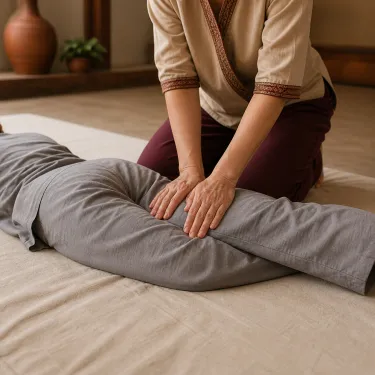
What is Thai massage? It is the one people describe afterwards by moving their shoulders around rather than by talking. There is no oil, you stay fully clothed, and instead of lying still while someone works on your back, you are moved — your legs, arms and spine are taken through stretches you cannot hold on your own. If you have only ever had an oil massage, it is a genuinely different hour, and this guide covers what actually happens in it.
What is Thai massage, exactly?
Thai massage developed in Thailand and is often called ‘assisted yoga,’ which is a fair shorthand as long as you understand who is doing the work. You are not holding the positions. The therapist moves you into them, holds them for as long as the muscle needs, and takes you out again.
The other half is pressure. Rhythmic compressions with palms, thumbs, forearms, elbows and feet run along the body in lines rather than muscle by muscle. Those lines are the Sen lines, and following them is what makes the sequence feel like it has a direction to it — you can usually tell what is coming next.
Put together, it is deep work and mobility work in the same session. That combination is the reason people book it, and it is the reason it does not feel like anything else on the menu.
No oil, and you stay dressed
This surprises most first-timers, so it is worth saying plainly: nothing is applied to your skin and you keep your clothes on. Wear something you could stretch in — leggings, joggers, a t-shirt. Jeans and anything with a stiff waistband will fight the session.
Because the clothes stay on, they matter more here than in any other treatment. What to wear to a Thai massage is a thirty-second read that removes the one thing first-timers get wrong.
Two practical consequences follow. There is nothing to shower off afterwards, so you can dress and go, which makes it the one session that genuinely fits into a lunch break. And because there is no glide, the pressure lands differently: it presses and levers rather than sliding, which is why the sensation is closer to a firm stretch than to a rub.
What happens in a session, start to finish
Every therapist runs it slightly differently. Here is how the hour goes at this studio.
Warming the Sen lines. We open with rhythmic palm and thumb compressions down the legs and along the back. This is not filler — it is how I find where you are actually holding, and it gives the muscle a few minutes to soften before anything is asked of it.
The big three. Most of the hour goes to hips, back and shoulders, using hands, forearms, elbows and feet to press and lever the joints open. Working along the Sen lines rather than muscle by muscle means a tight hip gets addressed through everything connected to it, not only where it hurts.
Assisted stretching. Then the yoga-style half. Your legs, arms and spine are moved through stretches you could not hold alone, each joint opening while the muscle around it is already warm. This is the part people remember.
The finish. A short neck and shoulder release to settle everything down.
The 90-minute session spends its extra half hour mostly on hips and legs — intensive passive stretching through the hamstrings, hip flexors and glutes, each position held long enough for the muscle to let go rather than simply be pulled — and adds a dedicated sequence of spinal twists and chest openers that an hour has to skip. It finishes with the traditional Thai release across the scalp, jaw and neck.
Does Thai massage hurt?
It should be strong and it should not be painful. There is a real difference between a stretch that has found its end range — which you will feel clearly, and which you can breathe through — and a sharp, bright pain that makes you brace. The first is the work. The second is a signal to say something.
Does Thai massage hurt takes that question on properly — what compression, leverage and assisted stretching each feel like, which areas people find strongest, and the difference between strong and wrong.
Saying something is not an interruption; it is how the session gets calibrated. Pressure and depth are adjustable at every point, and a therapist would far rather hear ‘that is too much’ than have you hold your breath through twenty minutes of it. Bracing against pressure tightens exactly the muscle the pressure is trying to reach, so the session works less well, not more.
Most people are a little tender the next day, in the way a good training session leaves you tender. It is not a sign anything went wrong.
Breathing is the part nobody mentions and the part that changes the session most. When a stretch reaches its end range, the instinct is to hold your breath and grip. Letting the breath out slowly at that exact moment is what allows the position to open another inch, and it is the difference between a stretch that stops where you started and one that gains you something. If you take nothing else into your first session, take that.
Where Thai massage comes from
The practice developed in Thailand, where it grew up alongside the country's traditional medicine rather than inside the European massage tradition that gave us Swedish technique. That difference in ancestry explains most of what feels unusual about it: the emphasis on lines rather than individual muscles, the assumption that a body should be moved rather than only pressed, and the fact that oil never entered the picture.
You will see a great many confident claims online about exactly how old it is and precisely who founded it. Those stories vary depending on who is telling them, so we will leave them alone. What matters in the room is that the sequence is old, it is coherent, and it has been refined by a very large number of people over a very long time — which is why it holds together as an hour rather than feeling like a list of stretches.
Traditional Thai massage vs a Thai-style blend
This trips people up when they read a treatment menu, so it is worth separating. Traditional Thai massage is the one described above: no oil, clothed, compression and assisted stretching, start to finish.
If it will be your first one, what to expect at a first Thai massage runs through the hour in order — what to wear, how firm it gets, and the two things worth saying out loud.
A Thai-style blend is something else — a session that borrows the stretching and folds it into oil work. Our signature sessions do exactly that, pairing Thai technique with deep tissue and Swedish massage in the same session, and there is a stretching-and-Swedish session that leans further toward the relaxing end. Those use oil, so you undress as you would for any oil massage, and there is a shower to think about afterwards.
Neither is better. They answer different questions. Traditional Thai is the choice when mobility is the point and you want to leave dressed; a blend is the choice when you want the stretching but would also like your back worked over with warm oil for half of it.
What is Thai massage good for?
The desk body. If your hips have tightened from sitting and your shoulders have crept up toward your ears, this is the hour built to undo it. Sitting shortens the front of the hip and closes the chest, and assisted stretching reaches both directly.
Athletes and people who train. It works well as a structural tune-up between training blocks, and it is a reliable way to find out which side is actually tighter — something you often cannot feel until someone moves you symmetrically and one side stops earlier than the other.
Anyone who wants the effects of a long yoga class without doing one. You lie there; the range comes from the therapist. All of the opening, none of the holding.
Anyone short on time. No oil means no shower afterwards. Sixty minutes covers the three areas that matter most and you can go straight back to your day.
When something else is the better choice
Thai massage is not the answer to every complaint, and it is worth saying which ones it is not.
If you have one specific knot — a tight band between the shoulder blades, one spot in the glute that has been there for a month — sustained, focused pressure on that spot will usually serve you better than a whole-body mobility session. That is deep tissue work, and the honest comparison between the two is in our guide to thai massage vs deep tissue.
If what you want is to stop thinking for an hour, a Swedish oil session does that better — and if the tiredness is not really in your muscles at all, aromatherapy massage is the one built for that, with the pressure kept deliberately gentle throughout. Thai massage is engaging: you are being moved, and you are participating in your own breathing. Restful, but not passive.
And if you are pregnant, recovering from surgery, managing a flare-up of a diagnosed condition, or taking blood thinners, say so when you book. Massage eases tension and helps you move more freely; it is not medical care and it is not a substitute for it. Some conditions call for a different treatment, a modified session, or a word with your doctor first — that conversation takes a minute and it belongs before the session, not during it.
How long should your session be?
Sixty minutes is a sensible introduction, especially if every massage you have had so far involved oil. It covers hips, back and shoulders properly and lets you find out what assisted stretching feels like before committing to more. The 60-min Traditional Thai Massage is $130.
Ninety minutes is the shortest Thai session that reaches the whole body, feet to scalp, without hurrying any part of it. If you sit all day and train in the evenings, this is usually the one that fits, at $195.
The two-hour session, which adds cupping, brings in the vacuum therapy alongside the stretching — suited to chronic stiffness and athletic recovery, at $260. You can compare every session and its price on one page.
After your session
Expect to feel taller and looser, and expect it to be noticeable in ordinary movements first — reaching into a back seat, turning to look behind you, standing up from a low chair. Some people feel energised and some feel pleasantly heavy; both are normal, and which one you get says more about how much sleep you have had than about the massage.
Drink water, and keep moving gently rather than sitting straight back down for four hours. A short walk in the evening holds the range you have just been given far better than the sofa does. Whatever you gained, the way to keep it is to use it.
Booking Thai massage in Newport Beach
Sessions are at 4120 Birch St, Ste 104, in The Hangers, Newport Beach, and the studio is open daily from 8am to 9:30pm, and from 8:15am on Mondays. Yolie is CAMTC-certified with around ten years of experience, and the room is one therapist and one client — you see the same therapist every time.
If you are still deciding, say what is bothering you when you get in touch and you will get a straight recommendation, including when the answer is a different treatment. You can book a session online or call (559) 655-9555. One thing to know in advance: appointments cancelled less than four hours ahead are charged in full, so if your day is uncertain, book the time you are sure of.