
Massage for desk workers: the neck and shoulders, specifically
The ache from a laptop has a shape, and it is the same shape in almost everyone. Here is where it comes from, what half an hour can actually change, and what to fix at the desk so it stops coming back.
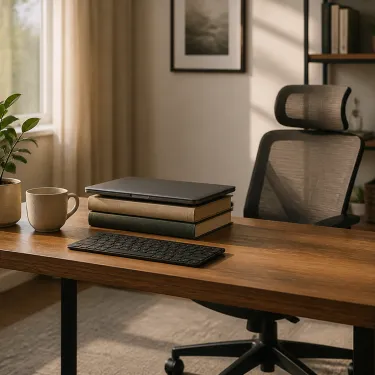
Massage for desk workers is a narrower problem than it sounds, because the ache from a laptop has a shape and it is nearly the same shape in everyone: the band across the tops of the shoulders, the strip between the shoulder blades, and the base of the skull. That is worth knowing, because a problem with a shape has a treatment with a shape.
Where the tension actually sits
Three places, and they are not where most people point.
The tops of the shoulders. Arms held forward at a keyboard for eight hours are being held up all day by the muscle across the top of the shoulder. Nothing dramatic is happening; it is simply never off duty.
The base of the skull belongs on that list too, and it has a name people now use for it. Tech neck is the weight-and-lever version of the same problem — ten to twelve pounds of head held out on the end of a lever all day.
Between the shoulder blades. This is the one people describe as a knot and reach for over the shoulder without ever quite getting to. It is the mid-back doing the work of holding you upright while the front of your chest gradually shortens.
The base of the skull. A screen that sits below eye level means a head tipped forward, and a head is heavy. The muscles at the base of the skull spend the day stopping it falling further.
Notice that only one of those is the neck itself. That is why rubbing your own neck at the desk does so little: the neck is where you feel it, and the shoulders and mid-back are where it is being generated.
Why thirty minutes is the right booking
The instinct is to book a full hour and have the whole body done. For this specific complaint that is often the worse choice, and the reason is arithmetic.
An hour spread over a whole body gives the upper back perhaps fifteen minutes. Thirty focused minutes gives it thirty. If the problem is genuinely above the waist — and for a desk worker it usually is — the shorter session puts more work exactly where the trouble is.
The 30-min Neck, Shoulder & Back Massage is $75 and is deep-tissue pressure throughout: the upper back, the band across the shoulders and the base of the neck, and deliberately nothing else. No time goes to legs or feet. It works precisely because all of it lands in one place.
It also fits in a lunch break, which is the difference between a treatment you book when it gets bad and one you book before it does.
What the thirty minutes actually contains
Three things, and the third is the one that makes it work.
Deep-tissue pressure, not a light rub. The session is described on its own page as a 30-minute deep tissue massage, and that is what it is — the same pressure as the hour-long version, in a smaller area.
Only where a desk loads. The upper back, the band across the tops of the shoulders, and up into the base of the skull. Between the shoulder blades gets real time rather than a passing stroke.
Nothing spread thin. No minutes go to legs or feet. That is not a limitation being apologised for — it is the reason a half-hour session can do anything at all. Thirty minutes divided across a whole body would give the shoulders about four.
It is also the only session on the menu shorter than an hour, which tells you what it is for.
When to book longer instead
Half an hour is the right answer to a specific, familiar upper-body ache. It is the wrong answer to three other situations.
If you want the same pressure everywhere, book the 60-minute deep tissue session instead — the half hour deliberately does not try to be a full-body treatment, and the studio says so on the page rather than letting people discover it on the table.
If it is not one area but all of it, ninety minutes is the length that reaches the glutes, IT bands, calves and base of the skull in one visit. The guide to deep tissue massage covers how the lengths differ and how sore to expect to be.
And if what you actually want is to stop thinking for an hour rather than to have a spot worked, that is a different treatment altogether — a Swedish massage covers everything at a pressure you enjoy, with no next-day tenderness.
The other sessions that reach the same area
Four things on the menu work above the waist, and the difference between them is coverage, not quality.
30-min Neck, Shoulder & Back, $75. Deep pressure, upper body only, fits a lunch break.
60-min Deep Tissue, $130. The same pressure with room for one more area, or for the upper body worked more slowly.
90-min Deep Tissue, $195. The whole body, including the glutes, IT bands, calves and base of the skull that shorter sessions never reach.
60-min Swedish, $120. Gentle to moderate rather than deep, and most of the hour goes to the back, neck and shoulders — the same region, at a pressure you can fall asleep through.
If you have been going back and forth between these, the question that settles it is not how bad the ache is. It is whether you want one region worked hard or all of you worked evenly.
What half an hour can and cannot do
It can change how your shoulders feel, and it can make it obvious which side you actually favour — which is usually a surprise, because you cannot feel an asymmetry until someone works both sides the same way.
It cannot outrun the desk. Nothing done in thirty minutes competes with forty hours a week in the same position, and any treatment sold as if it could is being sold dishonestly. What a regular session does is stop the tension compounding — keeping a manageable problem manageable, rather than letting it become the kind that needs a longer, firmer and more uncomfortable appointment.
That is a genuinely useful thing to buy. It is just not a cure for your job.
How often is worth it
There is no schedule anyone can hand you honestly. What can be said is the practical point: at $75 for thirty minutes this is the least expensive session on the menu, which is what makes a repeat booking realistic rather than an occasional treat.
That matters more than it sounds. The tension is generated by a habit — the same chair, the same hours, every week — so a treatment you can afford to repeat fits the problem better than one long session booked once it has become unbearable.
The four desk fixes that actually matter
In rough order of how much they change, and all of them free.
Raise the screen. The top of the screen should be at about eye level. A laptop on a desk is guaranteed to be too low, which is why a stack of books under a laptop and a separate keyboard beats almost any chair upgrade. This is the single biggest one.
Bring the keyboard closer. Elbows near your sides at roughly a right angle. Reaching forward is what keeps the tops of your shoulders working all day.
The mouse hand is the half of that nobody moves. Shoulder pain from a computer mouse covers why the tension is almost always one-sided, and the six changes that genuinely unload it.
Get your feet flat. Feet on the floor or a footrest, hips slightly above knees. A pelvis that is tipped back rounds the whole spine above it, and the mid-back pays for that.
Move every half hour. Not a workout — stand up, walk to the kettle, look out of a window at something far away. The problem is not any single posture, it is holding one for four hours. A posture you change is rarely the one that hurts you.
If the ache has moved lower down rather than staying above the waist, the guide to what sitting does to your lower back is the one to read — it is the same cause with a different address.
When it is not the desk
Most of the time it is the desk. Sometimes it is not, and it is worth knowing the difference.
Pain that runs down an arm, numbness, pins and needles, weakness in the hand, or a headache that is unlike your usual ones is not something to book a massage for and see how it goes. See a doctor first. Massage eases tension and helps you move more freely; it does not diagnose anything, and a therapist who tells you what a nerve symptom means is out of their depth.
Say so when you book if you have a diagnosis, are recovering from an injury, or are taking blood thinners. It changes how the session is worked, and it is a one-minute conversation beforehand rather than a discovery halfway through.
Booking in Newport Beach
Sessions are at 4120 Birch St, Ste 104, in The Hangers, Newport Beach, open daily from 8am to 9:30pm, and from 8:15am on Mondays — including early enough to go before work and late enough to go after it, which for this particular complaint is most of the point. Yolie is CAMTC-certified with around ten years of experience, and the room is one therapist and one client, so the side that was worse last month is already known this month.
Say what your setup is when you book — laptop or monitor, home or office, how many hours — and the session is aimed accordingly. You can book a session online or call (559) 655-9555, and every treatment and price is on one page. One thing to know in advance: appointments cancelled less than four hours ahead are charged in full, so if your day is uncertain, book the time you are sure of.