
Thai massage vs deep tissue: which is right for your pain?
Two powerful techniques, two very different approaches. A practical guide to choosing the right one for your body and your goals.
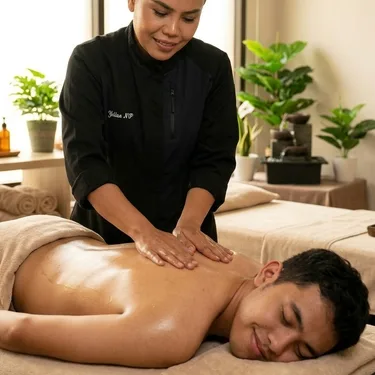
Thai massage vs deep tissue is the question we are asked more than any other, and it is a fair one. Both go deep, both relieve real pain, and they get there in completely different ways — which is why picking the wrong one leaves people thinking massage did not work for them. Here is how to tell which one your body is actually asking for.
Thai massage: movement and space
Traditional Thai massage is often described as ‘assisted yoga.’ There's no oil and you stay clothed. Instead of working on a flat table, I use my hands, forearms, elbows, and feet to move you through a sequence of rhythmic compressions and passive stretches along the body's energy lines.
The goal is to open your joints, lengthen your muscles, and restore range of motion. If you feel stiff, ‘locked up,’ or like you've lost flexibility, Thai massage creates space where things have gotten tight.
Thai massage is a strong fit if you:
- Sit for long hours and feel stiff through the hips, back, and shoulders
- Want to improve flexibility and range of motion
- Prefer a treatment that feels active and energizing rather than sedating
- Don't love the feeling of oil or lying still the whole time
Deep tissue: pressure and precision
If you want the long version first, what deep tissue massage actually is covers the cream, the pressure and how sore you should expect to be.
Deep tissue massage is the opposite approach — focused, static, and targeted. Using warm oil and slow, deliberate strokes, I work across the grain of the muscle to reach the deepest layers: the chronic knots and ‘muscle armor’ that build up from stress and repetitive strain.
This is corrective work. If you have a specific problem area — a stiff neck, a locked shoulder, a lower back that won't let go — deep tissue goes straight to it.
Deep tissue is a strong fit if you:
- Have specific knots or localized pain rather than all-over stiffness
- Carry chronic tension from stress, training, or heavy physical work
- Want firm, concentrated pressure on your trouble spots
- Are recovering dense, tight muscle that lighter work doesn't reach
Thai massage vs deep tissue: a quick way to choose
Think stiffness or think knots. Stiffness that needs opening up leans Thai. A stubborn knot that needs breaking down leans deep tissue.
Here's the simplest test I give clients:
- ‘I feel tight and inflexible.’ → Thai massage.
- ‘I have one spot that's really painful.’ → Deep tissue.
- ‘Both — I'm stiff and knotted.’ → You're not alone, and you don't have to pick.
Why you don't always have to choose
Most bodies aren't one or the other. That's exactly why our signature sessions combine them — deep tissue to break down the knots, Thai stretching to open the joints, and a Swedish finish to calm everything down. If you're unsure, a combination session gives you the best of both, and we adjust the balance to what your body needs on the day.
And there is a third answer worth naming: sometimes neither is right, because the tiredness was never in your muscles. If you finish a hard week flat rather than sore, pressure is not the tool — an aromatherapy massage keeps the pressure gentle throughout and puts the hour into scent instead.
Still not sure? Tell me where it hurts and how it feels, and I'll point you to the right treatment before you ever book.
What each one feels like in the room
Thai is an active hour. You stay clothed, there is no oil, and you get moved — your leg is lifted, your hip is opened, your spine is rotated. Some of it feels like a stretch you could not have reached on your own, because you could not have.
Deep tissue is the opposite posture. You are draped and still, and the work comes to you: forearm, elbow, thumb, held on one spot long enough for the tissue to give. The sensation is narrower and stronger, and it stays in one place while Thai keeps moving.
Neither should be an endurance test. Pressure that makes you hold your breath or grip the table is past useful and into bracing, and a braced muscle cannot release. Say so — it is a normal thing to say out loud, and the pressure changes immediately.
How you will feel the next day
After Thai, most people report feeling longer rather than sore — a looseness through the hips and shoulders, sometimes a mild ache in muscles that got stretched further than they are used to.
After deep tissue, a day of tenderness in the areas that were worked is ordinary, the way it is after a hard session at the gym. It settles within forty-eight hours. Drink water, keep moving gently, and do not book a heavy training day for the morning after.
If soreness is sharp rather than dull, or lasts beyond three days, the pressure was too much for that tissue on that day. Worth mentioning next time so the session is dialled differently.
If you have never had either
Start with deep tissue if you can point at the problem — one shoulder, the lower back, a calf that will not let go. Start with Thai if you cannot point at anything and just feel stiff, compressed, older than you are.
And if you genuinely cannot tell, book ninety minutes rather than sixty. The extra half hour is what makes it possible to work an area properly and still cover the rest of you, instead of choosing.
Once you have picked one, the next question is the interval — how often you should get a massage depends on whether you are maintaining, fixing something specific, training, or simply worn out.
One more thing worth knowing before you decide: neither treatment is a one-off fix for something that took years to build. What one session buys you is a clear read on which of the two your body responds to, and that is worth more than guessing for another six months.
Ready to pick? Read the full details for the 90-min Traditional Thai Massage or the 90-min Deep Tissue Massage — and if your body wants both, the Thai-Deep-Swedish combination blends them in one session.