
Sitting all day? Your lower back pain may start in your hamstrings
Prolonged sitting shortens the hamstrings and hip flexors — and your lower back pays the price. Here’s how Thai stretching and deep tissue work address the root cause instead of just the symptom.
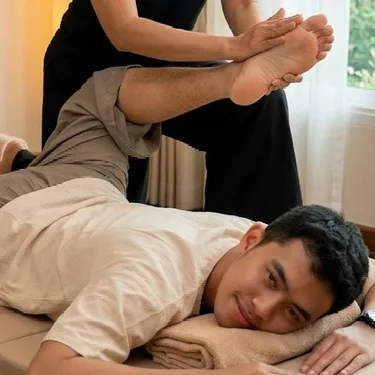
Lower back pain from sitting is the complaint we hear most often, and almost everyone who walks in with it blames the back itself. In a lot of cases the back is the victim rather than the culprit. The tension that started it usually sits lower down — in the hamstrings and hip flexors that a chair keeps shortened for eight hours a day.
Why sitting turns your hamstrings into a problem
When you sit, your knees are bent and your hips are folded for hours at a time. Your hamstrings — the muscles running down the back of your thigh — stay in a shortened position, and so do the hip flexors at the front. Hold any muscle short for long enough, day after day, and it adapts: it gets tighter and less willing to lengthen.
Here's the catch. Your hamstrings attach to your pelvis. When they are chronically tight they pull the bottom of the pelvis down and tuck it under, which flattens the natural curve of your lower spine and loads the very structures that are supposed to move freely. The result is a dull, persistent ache that no amount of stretching the back alone seems to fix.
Signs your lower back pain from sitting starts lower down
- Your back feels worse after sitting, not after activity.
- You can't touch your toes, or you feel the pull behind your thighs when you try.
- Standing up after a long stretch of sitting takes a few seconds to ‘unfold.’
- Stretching your back brings short relief, but the ache always comes back.
Why stretching on your own often isn't enough
Hamstrings that have been short for years don't release from a 20-second stretch. The tension lives deep in the muscle and in the surrounding fascia — the connective tissue that wraps and links your muscles together. To actually change it, you have to work the tissue and the joint together.
You can't out-stretch eight hours of sitting in ten seconds. The tissue needs pressure and time to let go.
How bodywork addresses the root cause
The treatment that suits this is the one that can stay on a specific area rather than covering all of you — deep tissue massage, worked slowly across the grain of the muscle, with the pressure calibrated to what you can breathe through.
This is where hands-on treatment does what solo stretching can't. Two approaches work especially well together.
Thai stretching
Traditional Thai massage moves your body through assisted, passive stretches. Because I support the weight and control the angle, your hamstrings and hips open further than they would on their own — safely, and without you having to force anything. Over a session the pelvis returns toward its natural position and the pull on your lower back eases.
Deep tissue work
Deep, deliberate pressure along the hamstrings and glutes breaks down the chronic knots and adhesions that keep the muscle locked short. Combined with the stretching, it gives the tissue a reason — and the room — to lengthen and stay that way.
What you can do between sessions
- Stand up and walk for two minutes every half hour. Movement beats any single stretch.
- When you do stretch your hamstrings, hold for at least 60 seconds and breathe into it.
- Set your chair so your hips sit slightly above your knees.
If your lower back pain keeps returning no matter what you do for the back itself, it may be time to look lower. Addressing the hamstrings and hips at the source is often the difference between managing the pain and actually getting past it.
How long it takes to feel different
One session usually buys relief that lasts a few days. That is not a failure of the massage — it is what happens when you release tissue in the morning and then sit on it for eight hours in the afternoon.
What people notice first is range: bending to put shoes on stops being a production. The ache itself tends to fade over two or three sessions a couple of weeks apart, and stays gone longer each time.
If you have been stiff for years rather than months, plan for a slower curve. Tissue that has been short for a decade does not lengthen in an hour, and anyone promising otherwise is selling something.
What makes it come back
Three things, in order of how often we see them. Sitting through lunch, because the one break that would have reset your hips gets spent at the same desk. Driving, which is sitting with the added tension of holding a position. And sleeping curled up, which keeps the hip flexors short for another eight hours on top of the working day.
None of those need fixing all at once. Standing up every hour for ninety seconds does more than a single heroic stretching session on Sunday, because the problem is duration, not intensity.
If the ache has settled above the waist instead — the tops of the shoulders, between the shoulder blades, the base of the skull — that is the same cause at a different address, and massage for desk workers covers where it comes from and what half an hour changes.
When it is not just your desk
Massage is for muscular tension. It is not a diagnosis, and there are patterns that belong with a doctor first, not a therapist.
Pain that shoots below the knee, numbness or pins and needles in a leg or foot, weakness when you push off that foot, pain that wakes you at night regardless of position, or anything that started with a fall or an impact — get those looked at medically before booking any bodywork. The same goes for back pain with fever, or with any change in bladder or bowel control, which needs urgent care rather than an appointment next week.
None of that is common, and none of it describes the ordinary end-of-day desk ache. But a good therapist would rather you rule it out than work around it.
If that sounds like your back, the two sessions that address it directly are the 90-min Stretching & Swedish Massage, which opens the hamstrings and hips, and the 90-min Deep Tissue Massage when the tissue itself has gone hard and needs pressure rather than length.