
What is deep tissue massage? A Newport Beach therapist explains
It is not a stronger Swedish massage, and the cream is the reason. Here is what deep tissue actually does, how much it should hurt, and when sixty minutes is the wrong booking.
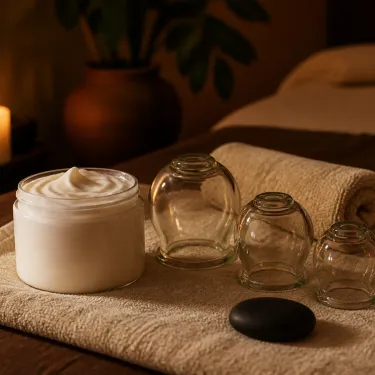
What is deep tissue massage? The short answer people give — ‘a hard massage’ — is the one that leads to bad sessions. Deep tissue is not a Swedish massage with the volume turned up. It is a different job done with different tools, aimed at one or two places rather than all of you, and the giveaway is the cream: it is chosen to grip rather than glide, because sliding smoothly over a knot is the one thing this hour must not do.
If you are weighing the two against each other before booking, deep tissue vs Swedish massage sets them side by side — the product on your skin, the shape of the hour, and which complaint each one is actually for.
What is deep tissue massage, exactly?
It is slow, sustained pressure worked across the grain of a muscle instead of along it, aimed at tissue below the surface layer — and at the fascia, the connective sheet wrapped around and between muscles.
The technique that defines it is cross-fibre work: strokes that run across the muscle fibres rather than with them, with concentrated friction on the specific spots you point out at the beginning. Pressure comes from forearms as much as from thumbs and elbows, because a forearm spreads the load over a wider surface and can therefore go deeper without becoming sharp.
It eases tension and it helps a stiff area move again. It is not medical treatment, it does not diagnose anything, and it is not a substitute for care from a doctor or physiotherapist.
The cream is the whole difference
This is the part nobody explains and it is the clearest way to understand the treatment.
An oil massage works because the hands glide. That glide is what makes long flowing strokes feel good, and it is exactly what makes deep work impossible — a lubricated hand slides past a knot rather than staying on it. So a deep tissue session switches to a high-grip cream, and the grip is the point. It lets a therapist park on one spot and work it instead of skating over it.
Two practical consequences. The sensation is closer to being leaned on than being rubbed, and the session cannot be silent: the therapist has to know where the spot is, and you are the only person who knows.
How a session runs, start to finish
Warming the surface. Broad, slow pressure over the whole area first. Working deep into a cold muscle is how people leave sore, so nothing sharp happens in the first ten minutes. If a session starts with an elbow in your shoulder blade, something has gone wrong.
The switch to cream. As above — from glide to grip.
Cross-fibre work. Slow, deliberate strokes across the grain, with concentrated friction on the spots you named. You will feel this. You should also still be able to breathe through it.
Flush and finish. Broad strokes to close, so the area is not left hot and guarding. Skipping this is why some deep tissue massages leave you feeling roughed up rather than released.
The 60-min Deep Tissue Massage is $130.
How much should deep tissue massage hurt?
There is a real line here and it is worth naming precisely, because ‘no pain no gain’ has done a lot of damage to this treatment.
Useful pressure is strong, dull and steady. You notice it, you can breathe through it, and your body stays soft underneath it. Unhelpful pressure is sharp, bright or makes you brace — and bracing is the reason it is unhelpful, not just unpleasant. When you tense against pressure you tighten the exact muscle the pressure is trying to reach. The session then works less, not more.
It helps to know what is under the thumb in the first place. What muscle knots actually are explains why a tender band refers pain somewhere else entirely, and why pressing one yourself buys about twenty minutes.
So saying ‘that is too much’ is not an interruption or a failure of toughness. It is the instrument the therapist is working with. A therapist would far rather adjust at minute twelve than find out afterwards that you spent an hour holding your breath.
Most people are a little tender the next day, in the way a hard training session leaves you tender. Sharp pain is a different thing, and soreness that is not settling is worth telling us about — and worth seeing a doctor about rather than a therapist.
What to say in the first two minutes
This treatment is calibrated by what you tell the therapist, so it is worth arriving with three things ready rather than assembling them while lying face down.
Where. Point at it. ‘My back’ and ‘the left side, just under the shoulder blade’ produce very different hours.
How long it has been there. Something that appeared on Tuesday and something that has been there since March get worked differently, and the second one is usually not fixed in a single session.
What makes it worse. Sitting, lifting, sleeping on one side, a particular movement at the gym — this is the part that tells a therapist which muscles to suspect rather than only which one hurts.
Deep tissue vs a firm Swedish massage
People often book deep tissue when what they wanted was a firm relaxation massage, and leave disappointed for a reason they cannot name.
The difference is not pressure, it is intent. A firm Swedish massage covers all of you at a pressure you enjoy, and the aim is how you feel at the end of the hour. Deep tissue is aimed at a place and a problem: less coverage, more time in one area, and the aim is how that area moves next week. One is a good hour. The other is a piece of work.
If you cannot point at the problem, deep tissue is probably not the booking. If you can point at it, nothing else is as direct.
Sixty, ninety, or two hours?
The lengths are not the same treatment at different sizes. They answer different questions, and picking wrong is the most common way to be disappointed by an otherwise good massage.
Sixty minutes is a targeted hour. One specific complaint — a stiff neck, a locked shoulder, a lower back that has been complaining for weeks. If you can point at it, an hour is enough, and it is also the right length for maintenance between longer sessions. It is not a full-body treatment, and the studio says so plainly rather than letting people find out on the table.
Ninety minutes is the whole body done properly. The extra half hour buys a real warm-up across the back, glutes and legs before anything deep begins, then forearm work through the largest muscle groups, then strokes held long enough for restricted fascia to give — the part an hour has to cut, and where the change lasts. It also reaches the glutes, the IT bands, the calves and the base of the skull: the four areas sixty minutes almost never gets to. At $195, the 90-minute session is the one to book when it is not one spot but all of it.
Two hours adds cupping, which is a different mechanism rather than more of the same — see below.
The two-hour session, and what cupping actually is
The 120-minute Deep Tissue Massage at $210 pairs the deep work with therapeutic cupping, and the two do opposite things on purpose. Deep tissue presses in. Cups use suction to lift — decompressing the tissue underneath rather than compressing it. While the cups are set, the surrounding muscle is worked with forearm pressure, so the area is being pulled and pushed in the same session.
The honest description of the marks: cupping commonly leaves round discoloured patches for several days. They look dramatic and they are not bruises in the usual sense — nothing has been struck — but they are visible, and if you have a wedding or a beach weekend coming, that is worth knowing before rather than after.
You will read confident claims online about cups drawing toxins out of the body. We are not going to repeat them. What can be said without stretching anything is that the suction decompresses tissue, that the sensation is unlike pressure and many people find it reaches stiffness that pressure alone has not, and that it suits dense, guarded muscle in particular.
Who deep tissue massage is for
One specific complaint you can point at. The clearest case, and the one an hour is built for.
Desk and screen tension. The upper back and the band across the shoulders take most of the load from a laptop day, and they are the easiest area to change in sixty minutes. If the trouble is lower down instead, our guide to what sitting all day does to your lower back is the better place to start.
Muscle that lighter work bounces off. Dense, guarded tissue that a relaxation massage simply does not reach.
Athletes and people who train. Between blocks rather than the day before a race — give yourself a couple of days. If the mileage has landed in your feet and calves rather than your back, reflexology reaches that directly and a full-body session only skims it.
When to book something else
If what you want is to stop thinking for an hour, this is the wrong treatment and you will spend the whole session concentrating. Book an oil massage instead, or an aromatherapy session if the tiredness is not really in your muscles at all.
If the problem is range of movement rather than a knot — hips that have shortened from sitting, shoulders that have crept upward — stretching work reaches that more directly than pressure does. The comparison worth reading is thai massage vs deep tissue, and the fuller picture of the stretching side is in our guide to Thai massage.
And speak up before booking if you are pregnant, recovering from surgery, managing a flare-up of a diagnosed condition, or taking blood thinners. Deep pressure and cupping are both things to discuss first rather than during. That conversation takes a minute.
After a deep tissue massage
Expect the worked area to feel warm and slightly tender, and expect the useful change to show up in movement rather than in how the muscle feels to press — turning your head further, reaching behind you without planning it.
Give yourself an unhurried exit rather than going straight from the table into something demanding, and leave a day before a hard training session if you can.
A dull ache the following day is ordinary and passes. Sore after a deep tissue massage gives the hour-by-hour version, and names the four things that are not part of the deal.
And if one area was the whole reason you came, book the next one before the tenderness has faded rather than waiting for the problem to return in full. You can compare every session and its price on one page.
Booking deep tissue massage in Newport Beach
Sessions are at 4120 Birch St, Ste 104, in The Hangers, Newport Beach, and the studio is open daily from 8am to 9:30pm, and from 8:15am on Mondays. Yolie is CAMTC-certified with around ten years of experience, and the room is one therapist and one client — which matters more here than in any other treatment on the menu, because the spot that needed work last month is already known this month.
Say where it hurts when you get in touch and you will get a straight recommendation, including the length — and including the times the answer is a different treatment altogether. You can book a session online or call (559) 655-9555. One thing to know in advance: appointments cancelled less than four hours ahead are charged in full, so if your day is uncertain, book the time you are sure of.