What is reflexology? A Newport Beach therapist explains
An hour on your feet alone, worked firmly in a set sequence with thumbs and a wooden tool. Here is what reflexology actually involves — and what we will not claim it does.
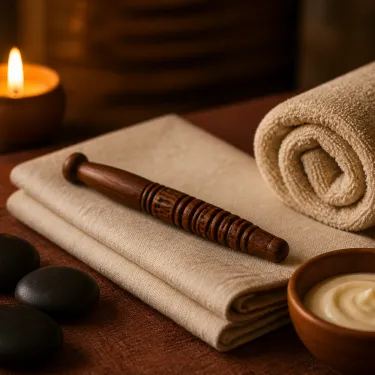
What is reflexology? At the level that matters when you are lying on the table, it is an hour spent entirely on your feet and lower legs, worked firmly and in a set order — thumbs, knuckles and a small wooden tool over the soles, heels and toes, rather than the vague pleasant rub the word ‘foot massage’ brings to mind. It is more thorough than people expect, and considerably firmer.
What reflexology is, and what we are not going to claim
The technique is specific. The soles, heels and toes are worked in a fixed sequence with firm pressure, concentrated on the areas that carry the most load, using a specialized wooden stick as well as thumbs and knuckles. The sequence is the thing that distinguishes it: a foot massage goes where it feels good, and reflexology covers the whole map whether or not a given spot is asking for it.
That map is where reflexology gets interesting and where a lot of nonsense lives. The tradition holds that particular zones on the sole correspond to particular organs and systems, and you will find confident claims that working a zone treats the organ. We are not going to make those claims. The evidence for them is not there, and a business that would tell you a thumb on your arch is treating your liver would tell you anything.
What is true is narrower and still worth an hour: feet carry your whole weight all day, they hold a surprising amount of tension, and almost nobody addresses them. An hour of firm, systematic work on a part of the body that never gets any is a genuinely different experience from an hour on your back. People walk out lighter on their legs. That is the honest sell.
How the session runs
Warm towel and cleanse. A warm towel wrap opens the session, softening the skin and settling you before any pressure arrives.
The cream. A massage cream or oil, often with peppermint or lavender through it.
The sequence. Firm pressure over the soles, heels and toes in order, using the wooden tool and thumbs. This is the part that is firmer than expected.
Deep work on arches and balls. Focused kneading where the load actually sits — the arch and the ball of the foot are where standing all day shows up first.
Up into the calves and ankles. The session does not stop at the ankle, which surprises people. Tight calves and stiff ankles are usually part of the same story as sore feet.
A warm towel to finish.
The 60-min Foot Massage & Reflexology is $120.
Does reflexology hurt?
It is firmer than a foot rub and it should not be painful, but it is the treatment where those two get closest together.
Feet are sensitive, the pressure is concentrated into a small area, and a wooden tool concentrates it further. Expect some spots — usually the arch, usually the ball of the foot — to be noticeably tender, in a way that most people describe afterwards as satisfying rather than unpleasant. As anywhere else, the line is whether you can breathe through it: strong and dull is the work, sharp and bright is a signal to say something.
If you are ticklish, say so at the start rather than discovering it together. Firm pressure applied deliberately is far less ticklish than light contact, and a therapist who knows will simply start firm.
The wooden tool, and why a thumb is not enough
People notice the stick and occasionally worry about it, so it is worth explaining.
The sole is thick and the tissue under the arch is dense, and a thumb is a fairly blunt instrument against it. A small wooden tool delivers pressure through a smaller, steadier point. That is the whole of it — it is a shape, not a mystery.
It is used with the same calibration as everything else: the therapist is watching, and it is adjustable at any moment. If it is too concentrated for you, thumbs and knuckles cover the same sequence more broadly. Say so.
What to expect the first time
Three things surprise people, and none of them is a problem if you know beforehand.
You stay dressed and lie on your back. Shoes and socks off, everything else on. There is no draping to negotiate and no face cradle.
It is not quiet work. An hour of firm, systematic pressure has a rhythm to it and you feel every part of the sequence. If you were imagining something drowsy, this is closer to a treatment than to a spa ritual — which is precisely why it does something.
Your calves get worked too. Tight calves pull on the heel, so a session that stopped at the ankle would be leaving out half of the reason feet hurt.
What a therapist is feeling for
The studio's own description of this treatment uses a phrase you will not find on many spa menus: the deep work on the arches and balls of the feet is there to release built-up tension and ‘crunchy deposits’.
That is an unglamorous and fairly accurate description of what dense, congested tissue feels like under a thumb after a few thousand miles of standing on it. Working it is what most of the firm part of the session is doing, and it is why the arch and the ball of the foot are the two places people report as tender. It is also why the treatment is described as something other than a rub — a rub goes over that; this goes into it.
How often is worth booking?
It depends entirely on what your feet do.
If you are on them all day for work, monthly is the pattern that keeps ahead of it, and the hour is short enough and cheap enough to make that realistic. If you run, book it in the recovery week of a training block rather than the week of a race. If neither applies and this is simply an hour you enjoyed, there is no schedule to keep — book it when your legs feel heavy.
What does not work is booking it once, in a crisis, and expecting it to solve a problem that took a year of standing on concrete to build.
Reflexology or an ordinary foot massage?
The honest answer is that here they are the same booking.
The session combines both: the sequence and firm zone work of reflexology, plus straightforward deep kneading of the arches and balls of the feet, plus the calves. Splitting them into two products would mean selling half a treatment twice. If you came for one and not the other, say so and the balance shifts — more time in the sequence, or more time simply working the tissue.
The 90-minute version is a hot stone treatment
Worth stating plainly, because the menu name does not: the 90-minute session at $180 is foot reflexology with hot stones.
Everything above happens, then smooth heated basalt stones are introduced and used as an extension of the therapist's hands, gliding over the arches and calves. While one foot is worked, warm stones sit between the toes or under the arch of the other, so the heat is continuous rather than arriving in bursts. The extra half hour also buys a properly intensive calf and lower-leg massage, which an hour has to keep brief.
What the heat is doing, described without stretching it: warmth makes muscle easier to work, so stiff tissue gives way to steady contact instead of requiring harder pressure. If your feet and ankles are habitually cold, or if you find it hard to switch off, the constant warmth is the reason to choose this one over the hour.
Who books it
People who are on their feet all day. Nurses, teachers, hospitality staff, anyone whose job has no chair in it. This is the treatment aimed squarely at that, and an hour on the feet does more for those legs than an hour on the back would.
Runners and hikers. Feet, arches and calves are exactly where the mileage lands, and they are exactly what a general full-body massage skims.
Anyone who cannot lie face down comfortably. This is the quiet one. Reflexology is worked while you lie on your back, fully clothed apart from your feet, which makes it the accessible option when a table with a face cradle is uncomfortable — a bad shoulder, a stiff neck, or simply not liking the position.
Anyone who wants a treatment they can go straight back to work after. Only your feet and lower legs are oiled.
Heel and arch pain: the careful version
A lot of people arrive with heel pain that a doctor has called plantar fasciitis, or with an arch that hurts for the first ten steps every morning.
Massage can ease the surrounding tissue and the calf tension that often accompanies it, and many people find that helpful. It is not a treatment for a diagnosed condition and it is not a substitute for seeing someone about one. If you have a diagnosis, say so when you book — it changes how firmly the area is worked, and there are days in a flare-up when the answer is to leave it alone. If you have not seen anyone about pain that has lasted weeks, do that first.
When something else fits better
If your problem is above the waist — a locked shoulder, an aching upper back — this is an hour spent nowhere near it. Deep tissue massage is the treatment that goes after a specific spot, and there is a 30-minute upper-body session for exactly that case.
If you want coverage and calm rather than one focused hour, a Swedish massage is the better hour. If the issue is that your hips and hamstrings have shortened rather than that your feet ache, Thai massage reaches that more directly, and the guide to sitting and lower back pain explains why the two are so often the same complaint. And every session, with prices and durations, is on one page.
Afterwards
Expect your legs to feel light — that is the effect the studio's own description leads with — and your feet to feel slightly tender in the way a good stretch is tender.
Wear shoes you can get on and off easily — this is the one treatment where that genuinely matters — and give the cream a little while before putting socks back on. A short walk in the evening suits it better than sitting straight down.
Booking reflexology in Newport Beach
Sessions are at 4120 Birch St, Ste 104, in The Hangers, Newport Beach, and the studio is open daily from 8am to 9:30pm, and from 8:15am on Mondays. Yolie is CAMTC-certified with around ten years of experience, and the room is one therapist and one client.
Say what your feet do all day when you book — standing, running, or neither — and the hour is shaped around it. You can book a session online or call (559) 655-9555. One thing to know in advance: appointments cancelled less than four hours ahead are charged in full, so if your day is uncertain, book the time you are sure of.