
What is Swedish massage? A Newport Beach therapist explains
The one that asks nothing of you. Here is what Swedish massage involves, why it is the right first booking, and what the two-hour version adds with heated stones.
What is Swedish massage? It is the one most people picture when they picture a massage — warm oil, long flowing strokes, and an hour that asks nothing of you. That last part is the whole design. Every other treatment on a menu asks you to tolerate something, decide something or participate in something. This one does not, which is why it is almost always the right answer to ‘I have never had a massage and I do not know where to start.’
What is Swedish massage, exactly?
A sequence of gentle-to-moderate strokes worked with warmed oil. The signature movement is effleurage — long, gliding strokes that follow the length of a muscle rather than crossing it — combined with kneading, and the oil is there so the hands glide rather than grip.
That glide is the technical difference from deep tissue work, which deliberately switches to a high-grip cream so the therapist can stay on one spot. Swedish moves along you. Deep tissue stops on you. Everything else follows from that one choice.
It eases tension, and an hour of it genuinely changes how a week feels. It is comfort and recovery work, not medical treatment, and it does not claim to be.
How the hour runs
Warm oil, long strokes. The session opens with gliding strokes using warmed organic oils. Nothing is asked of you in the first ten minutes; this is the part that settles the nervous system before any real pressure arrives.
The hold points. Most of an hour goes to the back, neck and shoulders — where sitting puts its tension. Gentle to moderate kneading, never enough to make you brace.
Winding down. The last stretch slows deliberately, so you leave calm rather than switched on. A session that stops abruptly wastes the previous fifty minutes.
The 60-min Swedish Massage is $120.
Why this is the right first massage
Three reasons, and none of them is that it is easy.
Nothing requires you to be brave. The pressure stays in a range you can drift through. Nobody is waiting for you to breathe through anything, and there is no moment where you have to decide whether to speak up.
You find out what you actually like. An hour of steady, moderate pressure tells you a great deal — whether you want more pressure next time, whether your shoulders were the problem after all, whether an hour is enough. That is hard to learn from a treatment that is fighting for your attention.
There is no next-day cost. Deep work can leave you tender for a day. This does not, so a first massage cannot accidentally ruin a Tuesday.
Office syndrome, which is most of why people book it
The particular ache that comes from a laptop, a commute and a chair has a shape: the upper back, the band across the shoulders, the base of the neck. Sitting shortens the front of the body and leaves the back holding on.
When the cause is pressure rather than posture, the reasoning changes a little. Swedish massage for stress explains why a treatment that asks nothing of you settles a braced nervous system faster than one you have to breathe through.
An hour covers the half of the body that carries it — and if you want only that half worked, harder, the thirty-minute upper-body session is the sharper instrument. An hour of Swedish is a sensible midweek booking rather than a treat saved for a special occasion — short enough to fit around work, long enough to change how the rest of the week feels.
If the trouble has gone past general tightness into one spot you can point at, that is a different treatment. Deep tissue massage is the one that goes after a specific knot, and the honest way to choose is whether you can point at the problem.
Does Swedish massage hurt?
No, and if it does, something has been misunderstood between you and the therapist.
Gentle to moderate is the working range, and moderate is a real amount of pressure — this is not a treatment where nothing happens. But there should be no point at which you brace, hold your breath or plan how to mention something. If you find yourself doing any of the three, say so in the moment; the pressure is adjustable at every second of the hour and adjusting it is not a complaint.
The other half of that is worth saying too. If you finish an hour thinking it was pleasant but nothing much happened, that is also information: ask for firmer next time, or book the treatment that goes after a specific spot instead. Neither outcome is a failed massage. Both are how you learn what your body wants.
The oils, and one thing to mention
The oils are premium organic ones, warmed before use, and the warming is not a flourish — cold oil on skin makes people tense at exactly the moment the session is trying to settle them.
If you have a nut allergy, sensitive skin, or a scent that reliably gives you a headache, say so when you book rather than on the table. Which oil is used is a question worth asking with an allergy, and it is a question that can be answered in advance and not halfway through a session.
How often is worth booking?
There is no clinical schedule and anyone who gives you one confidently is guessing.
What is worth saying is the trade-off, because people ask it as a budget question. If you are choosing between one 90-minute session and two 60-minute ones, the ninety covers your whole body and the sixty covers your back, neck and shoulders. Coverage is what this treatment sells, so if the tension is everywhere, one long session buys more of what you came for than two short ones.
Sixty or ninety minutes?
Ninety is not sixty with more pressure. It is sixty done slower, plus the parts an hour has to leave out.
Ninety minutes covers everything — back, legs, arms, hands, feet and scalp — and the extra half hour is spent going slower rather than doing more: longer strokes, longer pauses, and enough repetition on one area for it to stop guarding. The hands, feet and scalp work is the detail a 60-minute session never reaches, and for most people it is the reason they book it again.
Book ninety minutes at $180 if you are sleeping badly, if the body is tired but will not switch off, or if you want the relief of a long treatment with none of the next-day soreness. Booked late, it closes a day rather than interrupting it.
The two-hour session is a hot stone massage
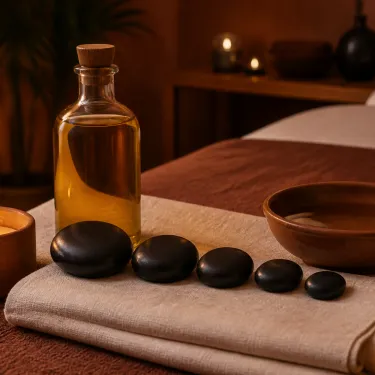
This is worth saying plainly, because the menu name does not: the 120-minute Swedish session at $270 is a Hot Stone Swedish Massage, and heated basalt stones are the reason it costs what it does.
It opens the same way — long rhythmic strokes with warmed oil to prepare the body. Then smooth heated stones are introduced as an extension of the therapist's hands: placed along the spine, in the palms and between the toes to ground the body, and then used to make slow gliding strokes over the larger muscle groups. Because there are two full hours, nothing is rushed; there is time for a hot stone foot sequence and a long neck and scalp finish, and the session closes with stone-free strokes so you come back up gradually.
What the heat does, described honestly: warmth makes muscle easier to work, so stubborn areas give way to slow, steady contact instead of needing sharp pressure. If you have found that deep pressure makes you tense up, this is the session that reaches guarded muscle by the opposite route — and the steady weight and warmth are the reason people describe it as quietening rather than merely relaxing.
It suits chronic stiffness, people who feel frozen or permanently cold, and anyone buying a gift who wants the most immersive thing on the menu.
Swedish vs the other treatments here
The short version, because choosing wrong is the most common reason a good massage disappoints.
Swedish when you want the hour itself to be the point — coverage, calm, no decisions.
Deep tissue when you can point at the problem and want it worked, and you accept a day of tenderness for it.
Reflexology when the trouble is your feet and lower legs rather than your back — an hour spent entirely there, worked far more firmly than the phrase ‘foot massage’ suggests.
Thai massage when the issue is range of movement rather than tightness — you stay fully clothed and you get stretched rather than rubbed.
Aromatherapy when the tiredness is not really in your muscles. Same gentle pressure as Swedish, with the hour built around a scent you choose.
All of them, with prices and durations, are on one page.
What to expect, practically
You undress to your comfort level and stay covered by a sheet throughout; only the area being worked is uncovered. There is oil, so there is a shower in your future — not immediately if you can help it, and wear something you do not mind.
You do not have to talk. Some people chat and some people fall asleep, and falling asleep is not rude — it is arguably the review. The one thing worth saying out loud is if the pressure is too light or too firm, at any point. Gentle to moderate is a range, not a fixed setting.
And say beforehand if you are pregnant, recovering from surgery, managing a flare-up of a diagnosed condition, or taking blood thinners. Some of those call for a modified session or a different treatment, and that is a one-minute conversation before rather than during.
After a Swedish massage
Expect to feel slow and warm rather than energised, and expect it to last the evening rather than the hour. This is not the booking to make before something demanding.
Give yourself an unhurried exit rather than standing up from the table and immediately driving somewhere. Booking it late, with nothing after it, is how the session is designed to be used.
Booking Swedish massage in Newport Beach
Sessions are at 4120 Birch St, Ste 104, in The Hangers, Newport Beach, and the studio is open daily from 8am to 9:30pm, and from 8:15am on Mondays. Yolie is CAMTC-certified with around ten years of experience, and the room is one therapist and one client — so the pressure you settled on last time is already known this time.
If this would be your first massage, say so when you book. It changes how the session is explained, not how it is performed, and it is the single most useful thing you can mention. You can book a session online or call (559) 655-9555. One thing to know in advance: appointments cancelled less than four hours ahead are charged in full, so if your day is uncertain, book the time you are sure of.