
What is aromatherapy massage? A Newport Beach therapist explains
You choose the blend before anything else happens, and the pressure stays gentle the whole way through. Here is what an aromatherapy massage actually involves, and when a body scrub is the better booking.
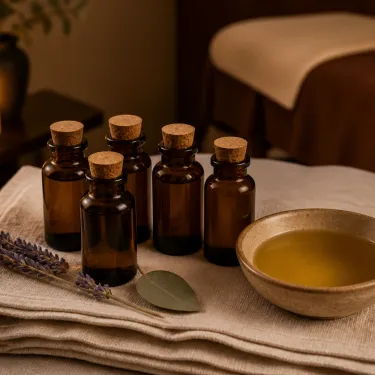
What is aromatherapy massage? It is the one session that starts with a question rather than with your back. Before anything is warmed or applied, you choose a blend — highly concentrated essential oils drawn from herbs, flowers and fruit — and that choice changes the hour that follows more than any decision you make about pressure. Everything after it is a flowing, gentle-to-moderate massage carrying those oils into the skin. If you have been booking deep tissue and leaving unsatisfied because the tiredness was never really in your muscles, this is the hour built for the other kind of tired.
What is aromatherapy massage, exactly?
Two things happening at once. The first is an ordinary, competent oil massage — long flowing strokes, warmed oil, the pressure held deliberately in the gentle-to-moderate range. The second is the scent, which is not decoration. The blend is chosen for you rather than poured from whatever bottle is nearest, and it is present for the whole hour.
You will find a great deal written online about exactly what essential oils do once they are on your skin, stated with more confidence than the evidence supports. We are going to leave those claims alone. What can honestly be said is narrower and more useful: it is a real massage, the pressure never asks you to brace, and the room smells of something you picked. People book it because that combination changes a mood, and sixty minutes is usually enough to do it.
It is comfort work. It eases tension and it is a genuinely restorative hour. It is not medical treatment and it is not a substitute for any.
The scent consultation comes first
The session opens with choosing the blend, and it is worth arriving with some idea of what you are after rather than deciding under pressure on the table.
The useful question is not ‘which oil is best’ — there is no such thing — but what you want the hour to be. Something bright and sharp reads as waking-up; something soft and heavy reads as winding-down. If you are booking at six in the evening to end a day, and you choose the scent equivalent of an espresso, you will get a lovely massage that fights its own purpose for an hour.
Say if a scent has ever given you a headache, and say if you are sensitive to anything. These are concentrated oils. A blend that is wrong for you is not a small problem when it is going to be six inches from your face for an hour, and swapping it takes thirty seconds at the start and is impossible in the middle.
What happens in a 60-minute session
Choosing the blend. As above. A minute or two, and it sets the tone for everything after.
Warmed and applied. Rhythmic, flowing strokes carry the warmed oils into the skin. The pressure stays gentle to moderate throughout — this is a session you smell and feel, not one you brace against.
Back, neck and shoulders. An hour goes where stress sits highest. That means the areas you notice first are the ones that get the time, and it also means an hour does not reach all of you. Which is the honest reason the ninety-minute version exists.
The 60-min Aromatherapy Massage is $140.
Does it hurt? No — and that is the point
This is the one session on the menu that never asks you to tolerate anything.
If you have had deep tissue work you will know the particular concentration it takes: breathing through a spot, deciding whether to say something, holding still. None of that happens here. The pressure stays in a range you can drift through, and nothing in the hour requires you to be brave. For some people that is exactly what they wanted and could not find a name for.
It also makes this a sensible first massage for anyone who has been putting one off because they expect it to be uncomfortable.
Is it just a Swedish massage with scented oil?
Nearly, and the difference is worth understanding before you pay for one over the other.
The hands are doing recognisably similar work. The ninety-minute session is explicit about it — the full-body portion is Swedish integration, flowing strokes over the whole body with your blend. So if you are imagining something exotic, adjust: the technique is familiar.
What is different is that the blend is chosen rather than default, it is the same one for the whole session, and the hour is built around it staying present. A Swedish massage where the therapist happens to be using a scented lotion is not the same thing, in the way that a glass of wine with dinner is not a tasting. The scent is the organising idea rather than a by-product, and the pressure is deliberately kept low enough that it never competes for your attention.
Which means the honest way to choose is by what you want to be paying attention to for an hour.
How often is worth booking?
There is no clinical schedule to give you here and anyone who offers one confidently is guessing.
It is not a treatment that accumulates, in the sense that nothing gets worse between visits and nothing needs keeping on top of. So the useful question is not how often you should, but what you want it for: a reset after a flat stretch, or a fixed point in the calendar you can look forward to. Both are good reasons and neither needs a schedule.
If you find yourself booking it because something specific hurts, that is the signal to book something else instead.
Sixty minutes or ninety?
The difference is not intensity. It is coverage.
Sixty minutes covers the back, neck and shoulders properly. Ninety covers all of you — a full-body sequence slow enough for the oil to absorb rather than sit on the skin, then detail work through the hands, feet and scalp with pressure-point technique, which is the part an hour never reaches. It closes with long, light strokes so the session ends gradually instead of simply stopping.
Booked in the evening, ninety minutes at $210 tends to end a day properly rather than interrupt it. If you are choosing between them and the reason you are booking is sleep, choose the longer one.
The other Specialty hour: a body scrub
People comparing aromatherapy massage usually end up looking at the body scrub too, and they are easy to confuse because both are booked for how you want to feel afterwards rather than for a specific ache. They do completely different jobs.
A body scrub is a skin treatment. A customized sugar scrub and a body buffer take the dull surface layer off from shoulders to feet — brisk work, and the part you will feel most — then everything is lifted away with warm towels rather than a shower, which keeps the room quiet and the treatment continuous. What time remains goes into a vitamin-rich oil finish, so the skin is left soft rather than stripped. The 60-min Body Scrub is $130.
The 90-minute version is not simply a longer scrub. After the exfoliation comes a full Swedish-style massage with vitamin-rich oils — a treatment in its own right rather than a finishing layer — plus feet and scalp. At $195 it is the one to book if you want both jobs done in one visit.
So: if what you want is skin, book the scrub. If what you want is an hour that changes your mood, book the aromatherapy massage. If what you want is tension worked out of your back, book neither — that is a different treatment entirely, and there is a whole menu with every session and price on one page.
Two things to know before a body scrub
These come from the treatment's own notes and they matter more than most pre-appointment advice:
Do not shave beforehand. Freshly shaved skin is already irritated, and exfoliation on top of that is how a pleasant hour turns into a stinging one. Leave it a day.
Pregnant and nursing guests are advised against the body scrub. If that is you and you were looking for something restful, the aromatherapy massage is not the automatic answer either — tell us when you book, because pregnancy changes which sessions are appropriate and there is a prenatal massage designed around exactly that.
What aromatherapy massage is good for
When the tiredness is not in your muscles. This is the clearest case. Some weeks leave you flat rather than sore, and pressure does not reach that. A scent-led hour does, and it is the reason most regulars book it.
A sensory escape. Sixty minutes is enough to change a mood, which is often the entire reason for booking, and is a perfectly good one.
When deep tissue is too much. A full massage that never asks you to tolerate anything, with the oils and the scent carrying the hour that pressure would otherwise have to.
Sleep and winding down. Particularly the ninety-minute session, booked late.
When something else is the better booking
Being honest about this is more useful than selling you the hour you are reading about.
If you have one specific complaint — a band of tightness between the shoulder blades, a hip that has been wrong for a month, low back pain from sitting — gentle-to-moderate pressure is not going to resolve it, however good the blend is. You want sustained, focused work on that spot, and the comparison worth reading first is thai massage vs deep tissue.
If what you actually want is range of movement back — hips that have tightened from sitting, shoulders that have crept upward — that is stretching work rather than oil work. Thai massage is the one that does it, and you stay fully clothed for it.
And if you are recovering from surgery, managing a flare-up of a diagnosed condition, or taking blood thinners, say so when you book. That conversation takes a minute and it belongs before the session rather than during it.
After your session
There is oil on your skin, so unlike a clothed session there is a shower in your future. Not immediately — give it a few hours if your day allows, because the oil is still absorbing and washing it straight off is a waste of the last twenty minutes of the massage. Wear something you do not mind, and if you have somewhere to be, factor it in.
Expect to feel pleasantly slow rather than energised. That is the intended direction. Booking a session like this an hour before something demanding is a common mistake; booking it at the end of a day is what it is for.
The scent lingers on skin and hair for a while, which most people enjoy and is worth knowing if you are going straight into a meeting.
Booking aromatherapy massage in Newport Beach
Sessions are at 4120 Birch St, Ste 104, in The Hangers, Newport Beach, and the studio is open daily from 8am to 9:30pm, and from 8:15am on Mondays. Yolie is CAMTC-certified with around ten years of experience, and the room is one therapist and one client — you see the same therapist every time, which is how a blend that worked for you last time is still known this time.
If you are undecided between the aromatherapy massage and the body scrub, say what you want to feel like afterwards when you get in touch and you will get a straight recommendation, including when the answer is a third thing. You can book a session online or call (559) 655-9555. One thing to know in advance: appointments cancelled less than four hours ahead are charged in full, so if your day is uncertain, book the time you are sure of.