
Tech neck: what it actually is, and what changes it
An adult head weighs ten to twelve pounds, and small neck muscles hold it out on the end of a lever for nine hours a day. The mechanism, the four things that make it worse, and the changes that work.
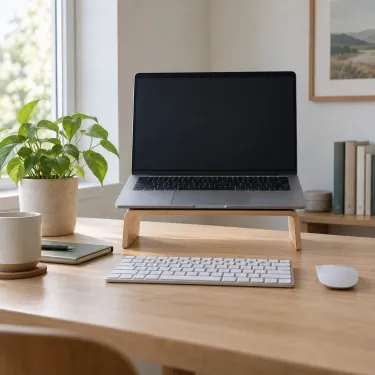
Tech neck is the ache that arrives at the base of your skull somewhere around four in the afternoon, and it is not a diagnosis — it is a description of what a head does when it spends nine hours tipped forward over a screen. The name is new. The mechanics are old, dull and entirely mechanical, which is the good news, because mechanical problems respond to mechanical changes.
What is actually happening
An adult head weighs roughly ten to twelve pounds. Balanced squarely over the shoulders, the muscles at the back of the neck barely have to work: the skeleton holds it up. Tip it forward to look down at a laptop or a phone, and those muscles have to hold that weight against gravity at the end of a lever. The further forward it goes, the harder they work.
They are not strong muscles and they were never meant to hold a static load all day. So they do what any muscle does under a long, low-level contraction: they stay short, they stop letting go at the end of the day, and they get tender in the same three or four spots on everybody.
That is the whole mechanism. No disc, no nerve, no mystery — just a small group of muscles that has been on for eight hours without a break.
How you know it is this and not something else
Typical tech neck is dull, symmetrical or nearly so, worse late in the day, better at weekends, and better again after a few days away from a desk. It often comes with a tight band across the tops of the shoulders and a headache that starts at the back of the skull and wraps forward.
What it is not: sharp, one-sided, travelling down an arm, or accompanied by pins and needles, numbness or weakness in the hand. Those belong with a doctor. Massage eases tight muscle and relieves the ache that comes with it; it is not medical care and it should not be used to work around a symptom that needs looking at.
The four things that make it worse, in order
Laptop height. A laptop puts the screen and the keyboard in the same place, which means one of your neck and your wrists is always wrong. It is almost always the neck. Raising the screen to eye level and using a separate keyboard is the single largest change available, and it costs less than one massage.
Duration without interruption. The load is not the problem; the constancy is. Standing up for sixty seconds every half hour does more than an elaborate stretch done once a day.
The phone. Two hours of evening scrolling is the same posture again, applied to a neck that already did a full shift. If the ache is worst at night, this is usually why.
Breath-holding under concentration. Most people stop breathing properly when they are focused, and shallow breathing recruits the muscles at the base of the neck to help lift the ribs. Those are the same muscles already holding your head up.
What actually helps between massages
Raise the screen. Books under the laptop work. So does the cheapest laptop stand you can find. The target is the top of the screen roughly level with your eyes.
Move the phone up, not the head down. Obvious, unnatural, and effective once it becomes habit.
Chin tucks, not neck rolls. Draw the chin straight back as though making a double chin, hold five seconds, release. Ten of those, twice a day. Rolling the head in circles feels better and does less.
Open the front. The chest tightens as the upper back rounds, and a tight chest pulls the shoulders forward, which puts the head further out. A doorway stretch for thirty seconds a side undoes some of that.
Walk at lunch. Twenty minutes with your eyes on the horizon instead of on a screen is the cheapest thing on this list.
None of it works if it is done once. What to do between massages goes into the rhythm properly, including the two habits that undo an hour of work faster than anything else.
Why the tender spots keep coming back
Because a tender spot in a muscle that has been contracted for months is not a knot you untie once. It is a small band of fibers that stayed short, and it goes back to being short if the eight hours that made it short do not change. What muscle knots actually are covers why pressing on one with your own thumb reliably fails, and it is worth reading before you buy another plastic hook.
This is also why the honest advice about massage for tech neck is a rhythm rather than a rescue. One session after six months of it feels wonderful and lasts a fortnight. A session every few weeks, alongside a screen that has actually been raised, is what keeps the ache from being a permanent feature of Thursday afternoon.
Which session is the right size
For the classic pattern — base of the skull, across the shoulders, between the shoulder blades — the 30-min Neck, Shoulder & Back Massage at $75 is deliberately narrow. It does not go anywhere near your legs, which is exactly why half an hour is enough, and it fits in a lunch break.
If the same area has been complaining for months rather than days, the 60-min Deep Tissue Massage gives an hour of concentrated work on one region, with slow cross-fibre pressure on the spots you point at rather than a general pass over everything.
And if the neck is only the loudest part of a body that sits too much, massage for desk workers maps the whole pattern — because the hips and the upper back are usually part of the same story.
The short version
Tech neck is a weight-and-lever problem, not a disease. Raise the screen, interrupt the hours, keep the phone up, and treat the muscles that have been on all day like muscles that have been on all day.
If yours has been getting worse for months, book a session and say which side of the neck is worse and when in the day it peaks. Both answers change how the time is spent.