
Your first Thai massage: what to expect when nothing about it is familiar
Fully clothed, no oil, and somebody moving your legs into positions you would not reach alone. Here is how the hour runs, what it feels like, and the two things to say out loud.
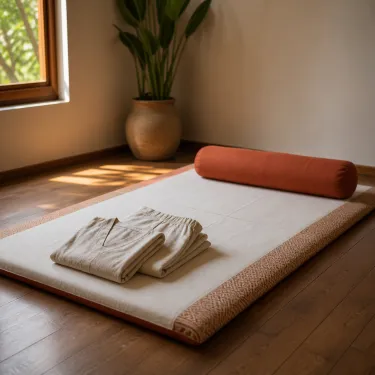
Knowing what to expect at your first Thai massage removes almost all of the strangeness, because the strangeness is entirely front-loaded: you keep your clothes on, no oil is used, and instead of being worked on while you lie still, you are moved — your legs, arms and spine taken through stretches you could not hold on your own. Everything about it is different from the oil massage most people picture, and none of it is difficult once you know the shape of the hour.
What to wear
Loose, comfortable clothes you can move in. Leggings or soft trousers, a t-shirt. Nothing with a stiff waistband, nothing with zips or buckles at the hip, and avoid a belt.
If you want the longer answer, what to wear to a Thai massage covers the fabrics that limit a stretch, the jewellery to leave at home, and what to do if you are coming straight from the office.
That is the whole preparation. There is no undressing, no draping to think about, and nothing on your skin at the end — which is exactly why a Thai session works as a lunch-break appointment when an oil massage does not.
How the hour runs
Warming the sen lines. The session opens with rhythmic palm and thumb compressions down the legs and along the back. It is not filler: it is how the therapist finds where you are holding, and it gives the muscle a few minutes to soften before anything is asked of it.
The big three. Most of the hour goes to hips, back and shoulders — the three areas that a day of sitting closes hardest. Hands, forearms, elbows and feet are all used to press and lever the joints open, following the sen lines rather than working muscle by muscle.
Assisted stretching. Then the yoga-like half. Your legs, arms and spine are moved through positions you cannot hold yourself, so each joint opens while the muscle around it is already warm. This is the part people remember.
The finish. A short neck and shoulder release to settle everything. With no oil on your skin, you dress and go.
The 60-min Traditional Thai Massage is $130, and sixty minutes covers those three areas properly — which is why it is the sensible length for a first session rather than committing to 90 or 120 minutes of something you have never felt.
Does it hurt?
It is firm, and it should not be painful. The useful test is the same one that applies to deep tissue: if you can breathe evenly through it, the pressure is working; if you are holding your breath or bracing against the stretch, it has gone past useful and should ease off.
The stretches are where first-timers tense up, usually out of politeness. Bracing against a stretch is the one thing that stops it working — the position is being held for you precisely so you can breathe into it instead of holding it yourself.
The two things to say out loud
“That is a bit much.” On pressure or on a stretch. It is information, not a complaint, and it takes one second to act on.
Anything your body is doing that a stranger cannot see. A knee that has been operated on, a shoulder that dislocates, a disc problem, pregnancy, high blood pressure — say it when you book, not when you are already in the position. Thai massage moves joints through range, so the history matters more here than in a treatment where you lie still.
Three things that surprise people
Feet and elbows are used, not just hands. Forearms, elbows and feet spread pressure over a wider area than a thumb can, which is why Thai work often feels broad and firm rather than sharp.
You are moved more than you are rubbed. There is far less of the long gliding stroke people associate with massage and far more compression, leverage and position. If you were expecting to lie still for an hour, the first ten minutes recalibrate that quickly.
It is more of a workout than it looks. Not effortful on your part — you are not holding anything — but a body that has been through a full stretch sequence knows about it, in the pleasant way a yoga class does.
What it feels like afterwards
Most people describe feeling taller and lighter rather than flattened — the sensation of range having been given back, not of having been worked over. A day of mild tenderness in the hips or hamstrings is normal if you are not someone who stretches; it fades like the ache after a decent yoga class.
Because there is no oil, there is nothing to shower off. Wear the same clothes back out and carry on with your day.
Is it the right first massage for you?
Thai suits you if you are stiff rather than sore: hips that will not open, shoulders that have crept toward your ears, a body that has tightened around a chair. It also suits anyone for whom undressing is the part that has been putting them off — the question simply does not arise.
It is the wrong first booking if you have one specific painful spot and want an hour of concentrated pressure on it; that is deep tissue, and Thai massage against deep tissue puts the two side by side. It is also the wrong choice if what you actually want is to be settled and half asleep — that is a long oil massage.
For the full explanation of the tradition, the sen lines and what is claimed for them, what Thai massage is is the longer read. If you are weighing it against everything else on the menu, which massage to get is the two-minute version, and what happens at a first massage covers the practicalities common to all of them.
Loose clothes, an empty-ish stomach, and ten minutes of margin so you are not still driving in your head when the hour starts — that is all the preparation there is. Book a session and say it is your first Thai one; the explanation changes, the work does not.