
What is cupping massage? The one technique that pulls
Everything else in a massage pushes. This is the one technique that pulls, which is why it reaches tissue that pressure keeps missing, and why it leaves round marks nobody warned you about.
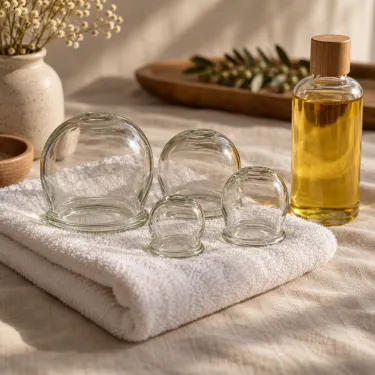
What is cupping massage? It is massage with suction added. Cups are placed on the skin and the air inside them is drawn out, so instead of pressing tissue down, the cup lifts it up. Everything else about a massage pushes. This is the one technique that pulls — which is why it reaches things that pressure alone keeps missing, and why it leaves round marks that alarm people who were not told about them.
How it works, mechanically
A cup is placed on oiled skin and a vacuum is created inside it. The skin and the layer beneath it rise into the cup. That decompresses the area: the fascia, the sheet of connective tissue that wraps and separates muscle, is lifted away from the muscle underneath, and blood is drawn toward the surface.
Two things follow from that, and both are the point.
Space. Fascia that has become stuck to the muscle beneath it is a large part of why some areas feel glued rather than merely tight. Pressing on stuck tissue compresses it further. Lifting it is the opposite instruction, and it is one the tissue often answers better.
Blood flow. Suction brings blood into an area that has been sluggish. That is why the skin goes pink or red, and why the area often feels warm afterwards.
The cups can be left in place for a few minutes or moved — slid over oiled skin in long passes, which feels like a broad, slightly strange pull rather than anything sharp.
What it feels like
Not like anything else, which is why people are curious about it.
The sensation is a firm, drawing tightness — a pull upward rather than a press downward. On a tight area it is strong and usually satisfying. It should never be sharp, burning or genuinely painful, and if it is, the cup comes off immediately. Say so; do not wait to see whether it settles.
Static cups feel intense for the first thirty seconds or so and then fade into a warm, slightly odd pressure you stop noticing. Moving cups feel more active and are usually the more comfortable of the two.
Afterwards, most people describe the area as looser and lighter, with a curious sense of space in it. Some feel tired for a few hours. Both are ordinary.
The marks
This is the part to understand before you book, because it is the part that surprises people.
Cupping frequently leaves round marks where the cups sat. They range from faint pink to a deep purple-red. They are not bruises in the usual sense — nothing has been struck, and they are usually not tender to touch the way a bruise is. They are blood drawn to the surface by suction, and they fade on their own, typically over several days to a couple of weeks depending on the person and the area.
Four practical consequences:
Do not book it the week before a wedding, a beach holiday or anything else backless. The upper back is the most commonly cupped area and the most visible one.
Darker marks are not a better session. The colour reflects the area and the person more than the quality of the work, and treating it as a score is how people end up asking for more suction than they need.
Tell your therapist if marks are a problem. Moving cups mark far less than static ones, and the session can be run that way.
They are not a sign of damage. But if an area stays painful, blisters, or does not fade within a few weeks, that is worth having looked at.
What cupping does and does not do
Worth being plain about, because this is a field with a great deal of confident marketing attached to it.
What it reliably does: makes a tight, stuck area feel looser and more mobile, particularly across the upper back, the lower back and the outside of the thigh. Reaches tissue that responds poorly to pressure. Feels different enough from ordinary massage that it often works when ordinary massage has stopped working.
What it does not do: remove toxins from your body, cure anything, or treat a diagnosed condition. Massage eases and loosens. If you have a medical problem, it belongs with a doctor, and cupping is not a reason to delay that.
The honest summary is that people who have tried it for stubborn, chronic tightness tend to keep asking for it, and that is a perfectly good reason to try it — not a reason to expect it to do things no massage does.
Who should not have it
Tell your therapist at the consultation if any of these apply, and check with a doctor first where relevant.
Blood-thinning medication or a bleeding disorder. Skin that is broken, inflamed, sunburnt or affected by a condition in the area to be treated. Varicose veins. Pregnancy — where some areas are avoided entirely. Recent surgery or an acute injury at the site. Very fragile or thin skin.
None of these is automatically a no, and several simply change where the cups go or whether they are used at all. What none of them can be is a surprise discovered after the fact.
Where the cups usually go
Three regions account for most of it, and they are the three that most reliably become stuck rather than merely tight.
The upper back and between the shoulder blades. The desk pattern. Dense, layered, and often unresponsive to yet another round of thumbs.
The lumbar region. Chronic lower back stiffness in a body that sits, where the muscle is not so much knotted as immobile.
The outside of the thigh. The band down the outer leg, which is famously uncomfortable to attack with pressure and responds noticeably better to being lifted than to being ground.
Glutes, calves and the tops of the shoulders come up too. Cups are not used on the face, over the spine itself, or anywhere the skin is broken.
Cupping is never the whole session
This is the thing people picture wrongly. Cupping is not an hour of sitting under suction — it is a technique used inside a massage, and the hands do most of the work before, during and after.
Here it is built into two of the two-hour sessions, and the sequencing is deliberate in both.
In the 120-min Deep Tissue Massage at $210, the session opens with high-grip deep tissue cream and broad warming strokes. Cupping is then integrated — decompressing the fascia while the cups are set, with forearm work ironing out the surrounding muscle fibers at the same time. Pressing and lifting in the same hour, which is the reason the combination works on knots that neither alone has shifted.
In the 120-min Traditional Thai Massage at $260, the order is different. Rhythmic compression along the Sen lines first, then a full sequence of assisted yoga stretches, and only then the cups — applied once the joints are open and the muscles already lengthened, to the areas of chronic stiffness that remain. Stretch first, decompress second.
Both are two-hour sessions, and that is not padding. Cupping needs the tissue warm and needs time afterwards for the rest of the body to be integrated rather than left with three treated patches.
How it compares with deep tissue
The clean way to think about it: deep tissue massage compresses, cupping decompresses.
Deep tissue is precise. You can point at a spot and have it worked, slowly, across the grain of the fibers, with a cream that grips rather than glides. It is the better answer for one identifiable knot.
Cupping is broad. It treats an area rather than a point, and it goes at the layer between muscle and skin rather than into the muscle belly. It is the better answer for a region that feels stuck, heavy or glued, and for tissue dense enough that pressure alone stops making progress.
The soreness afterwards is different too. Deep work can leave a dull ache the next day — the normal version of that is worth knowing before a first session. Cupping more often leaves a tender, sunburn-like surface feeling over the marks, with the muscle underneath feeling better rather than worse.
Cupping and heat
They are the two techniques here that do something pressure cannot, and they pull in opposite directions — which makes the choice between them clearer than it looks.
Heat softens tissue so it yields; suction lifts tissue so it separates. Hot stone massage is the gentler and more relaxing of the two by a wide margin, leaves no marks, and suits people who want depth without intensity. Cupping is the more targeted, more unusual and more athletic option, and it is the one to pick when an area has stopped responding to anything else.
If relaxation is the goal rather than a stubborn region, hot stone versus Swedish is a more useful comparison to read than this one.
For athletes
Cupping is popular in sport for a straightforward reason: dense, well-trained muscle is exactly the tissue that pressure struggles to get through, and a broad decompressing technique gets further with less discomfort.
Two scheduling notes that matter more than the technique. Leave several days between a cupping session and anything competitive — not because it impairs performance, but because a new sensation in a familiar body is a distraction nobody needs on race morning. And do not stack it with a hard training day; two sources of the same ache arriving together is how people conclude a treatment made them worse.
Sports recovery massage covers how this fits into a training week properly.
Aftercare, briefly
Keep the area covered and out of direct sun while the marks are visible — skin that has had blood drawn to the surface burns more easily. Skip the sauna, the hot tub and a hard workout for the rest of the day. Drink water because mild dehydration makes every post-massage ache feel worse, not because anything is being flushed out of you. And expect to feel loose that evening and looser the following day.
Is it worth trying?
If you have an area that has been tight for months, that deep pressure improves for two days and no longer, and you do not mind visible marks for a week or two — yes, clearly. It is the technique that most often changes something when the usual approach has plateaued.
If you are booking a massage to relax, or you have an event coming up where your back will be on show, this is not the one. There is no version of cupping that reliably leaves no mark at all.
Either way, say at the consultation whether you want it. It is built into the two-hour Thai and deep tissue sessions, and it can be left out of both. Book a session, mention the area that has stopped responding, and ask whether cups are the right answer for it — sometimes they are not, and that is a more useful conversation than a booking made on curiosity alone.