
What is hot stone massage? Heat as a tool, not a garnish
Heat does something pressure cannot: it lets a stubborn muscle soften without anybody pushing harder. The four phases of a session, what the stones are for, and the health conditions that rule it out.
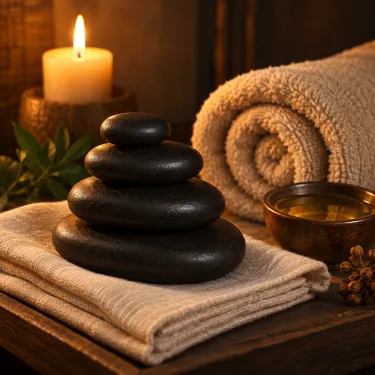
What is hot stone massage? It is a massage in which smooth, heated basalt stones are used as an extension of the therapist’s hands — placed on the body to hold warmth in one area, and glided over the large muscle groups to work them. The heat does something pressure alone cannot: it lets a stubborn muscle soften without anybody having to push harder. That is the whole idea, and it is the reason people who dislike being dug into often love it.
Why stones, and why basalt
Basalt is volcanic rock. It is dense, it has no sharp edges once it has been tumbled smooth, and — the property that matters — it holds heat for a long time and gives it up slowly. A warm towel is pleasant for ninety seconds. A basalt stone stays usefully warm for the length of a stroke and then the next one, which is what makes it a tool rather than a comfort.
The stones come in several sizes: large flat ones for the back and thighs, smaller ones for the neck and along the spine, and small ones for the palms and between the toes. They are heated in water, and a therapist always tests one against their own skin before it touches yours.
What a session actually looks like
It is not a treatment made of stones. It is a massage that uses them, and human hands are doing most of the work throughout. The full version here is the two-hour session, and it runs in four phases.
The warming phase. Long, rhythmic Swedish strokes with warmed organic oils, with no stones at all. This part settles the nervous system and warms the tissue. Introducing heat and depth into a cold, guarding muscle is how people end up sore, so nothing hurried happens here.
Thermal melting. Once the body has relaxed, the stones arrive. Some are placed and left — along the spine, in the palms, between the toes — which is the part people picture when they imagine hot stone massage. The rest are held and used: slow, deep gliding strokes over the larger muscle groups, the heat expanding the blood vessels underneath so that stubborn knots let go without the sharp, pointed pressure a thumb or an elbow would need.
Full-body integration. With two hours there is no need to hurry anything. A hot stone foot sequence, then the neck and scalp. This is the section most people remember afterwards, and it is the part a shorter treatment has to skip.
The cool down. The session closes with gentle, stone-free Swedish movements, so you come back up gradually rather than being tipped off the table.
What the heat is actually doing
Three things, and none of them is mysterious.
It widens blood vessels near the surface. More blood through warm tissue is why the area goes pink and why it feels alive rather than worked over.
It makes tissue more compliant. Warm muscle and fascia give more readily than cold. This is the same reason a stretch after a five-minute walk goes further than a stretch straight out of a chair.
It calms the nervous system. Sustained, even warmth with a little weight behind it is unusually good at quietening an overactive mind. Whether that matters to you more than the muscular effect depends entirely on why you booked.
What the heat does not do is remove anything from your body. Hot stone massage does not draw toxins out, and nothing needs to be flushed afterwards beyond ordinary sensible hydration. It eases, loosens and relaxes. That is plenty.
Who it suits particularly well
People who feel frozen rather than knotted. Persistent muscle guarding that resists ordinary massage often responds better to heat than to force, because force is what it is guarding against.
People who dislike deep pressure. This is the honest headline. If you want release without an elbow in your shoulder blade, heat is the way to get it. The depth arrives through the tissue rather than through the pressure.
Cold hands and feet. A very common reason people book it, and one of the most immediately satisfying.
Sedentary bodies. Long hours sitting produce exactly the pattern — sluggish circulation, stiff large muscle groups — that thermal work is good at.
An overactive mind at bedtime. The grounding weight of the placed stones is the part people describe as making their brain stop. If that is your reason, massage for stress and sleep is the wider view of what does and does not help.
Who should not book it
This matters more here than for most treatments, and it is the section to read twice.
Hot stone work is not appropriate for everybody. It is contraindicated for people with certain health conditions — including diabetes, heart disease, high blood pressure, some skin conditions, and recent acute injuries. Reduced sensation is the specific concern with diabetes: heat is safe when you can feel it accurately, and an area that cannot report temperature properly should not be treated with heat at all.
If you have a pre-existing medical condition, consult a healthcare professional before booking. Say so at the consultation as well — not as a formality, but because it changes whether stones are used, where, and for how long. A massage therapist is not a doctor and this article is not medical advice; what it is, is a reason to have one short conversation before the hour starts rather than during it.
If hot stone is ruled out for you, very little is lost. An oil massage at a comfortable room temperature gets to most of the same places by a different route.
How hot is it, and what if it is too hot?
Comfortably warm, not painful — and a therapist tests every stone before it touches you. The correct response to a stone that feels too hot is to say so immediately, and the correct number of seconds to spend being polite about it is zero. This is one of the few situations in a massage where waiting to see whether it settles is the wrong instinct.
Equally, if the room is warm and you are someone who overheats, say that too. The treatment can be run with fewer stones and more hands.
Hot stone and the rest of the menu
Three sessions here use heated stones, and they are not interchangeable.
The 120-min Swedish Massage at $270 is the signature hot stone treatment: two hours, stones throughout, including the foot sequence and the neck and scalp work. This is the full version, and the one to book if hot stone is the thing you came for.
The 90-min Foot Massage & Reflexology at $180 brings the stones to the feet and calves specifically — glided over the arches and lower legs, and placed between the toes or under the arch of one foot while the other is worked. For cold feet, tight calves or long days standing, this is a more direct answer than a full-body session.
The 120-Shiatsu & Thai Massage Fusion at $320 uses heat differently again: the stones warm the large muscles of the back and legs first, as a pre-treatment, so the body can surrender to a sequence of assisted stretches afterwards. Heat as preparation for movement rather than as the treatment itself.
Is two hours necessary?
For the full hot stone experience, yes — and that is a real constraint rather than an upsell. The warming phase cannot be rushed without making the stone work uncomfortable, and placed stones need time sitting on the body to do anything. Compress that into sixty minutes and you get an ordinary massage with a few warm objects in it.
If two hours is not the session you want, the honest alternatives are the foot-and-calf version above, or a straightforward oil treatment. How long a massage should be is a better frame for that decision than price is.
How it differs from a plain Swedish massage
A Swedish massage is long gliding strokes and moderate kneading with warm oil, and it is the default relaxation treatment for good reason. Hot stone is that, plus a heat source that stays in contact. The practical difference is how deep the session goes without going harder — and how much longer the relaxed feeling lasts afterwards, which is the thing people report most consistently.
Where the idea came from
Heated stones are not a spa invention of the 1990s, although the modern treatment protocol largely is. Warm stones have been used on the body in a number of traditions for a very long time, for the straightforward reason that a hot rock was for most of human history the most portable heat source available. What changed recently is the method: consistent stone sizes, controlled water heating, and a defined sequence that treats the stone as a massage tool rather than as a hot object placed on a sore back.
That distinction is worth holding on to when you compare treatments. A session where stones are laid on you and left there is a warm rest. A session where they are worked over the muscle, with hands taking over whenever hands are the better instrument, is a massage. The second one is the one worth two hours.
Why some stones are placed and left
The placed stones look decorative and are not. Sitting still on one area — along the spine, in each palm, between the toes — they do two things at once. They keep one region warm while the therapist works elsewhere, so no part of you goes cold and starts guarding again. And their weight has an effect of its own: a small, steady load on the body is one of the more reliable ways to make a nervous system stop scanning for threats. That is why people describe the placed stones as grounding rather than as warm.
It is also why the sequence matters. Warm first, place, then work, then finish without stones. Take the phases out of order and it becomes a pleasant hour with a gimmick in it.
As a gift
It is the treatment most often bought for somebody else, and it is a good choice for that — two hours, the most immersive session on the menu, and not something most people book for themselves. Gift certificates are arranged through the contact form rather than bought online, so ask and it will be sorted out.
One caveat if you are buying it for someone: the health conditions listed above are real, and the person receiving it may have one. Mentioning that the studio should be told about any medical condition beforehand is a kindness, not a complication.
Booking it well
Three things worth doing.
Mention any health conditions before the day. See the section above. It is the one part of this treatment where a surprise is genuinely unhelpful.
Do not book it for an hour before something demanding. Two hours of thermal work leaves most people pleasantly useless. Book it at the end of a day.
Say if you run hot or cold. It genuinely changes how the session is run.
Still deciding between this and something else entirely? Which massage should I get works through it by complaint rather than by name. And when you have decided, book a session — and say whether you are coming for the muscles or for the quiet. The answer changes where the stones go.