
Thai vs Swedish massage: opposites, and how to pick
One is done on a mat with your clothes on and no oil while you are moved through stretches. The other is warm oil on a table while you do not move at all. Nearly everyone has a preference.
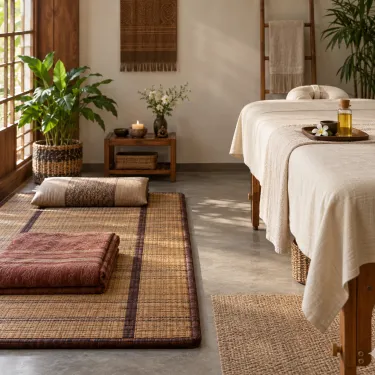
Thai vs Swedish massage is the clearest choice on any massage menu, because the two are opposites in almost every respect that matters. One is done on a mat with your clothes on and no oil, and you are moved through stretches. The other is done on a table under a sheet with warm oil, and you do not move at all. Nearly everybody has a strong preference once they have had both; the trick is working it out before you pay for the wrong one.
Side by side
Clothes. Thai: fully clothed, start to finish, no draping, nothing comes off. Swedish: undressed to your comfort, under a sheet, with only the area being worked uncovered.
Oil. Thai: none. Swedish: warmed organic oils throughout.
What the therapist does. Thai: rhythmic palm and thumb compression along the Sen energy lines, using hands, forearms, elbows and feet, then assisted yoga-style stretches. Swedish: long gliding strokes and moderate kneading.
What you do. Thai: stay passive while your limbs are moved. Swedish: lie still.
How it feels. Thai: strong, broad, occasionally startling, and quite active. Swedish: continuous, predictable, soothing.
Afterwards. Thai: taller, looser, more mobile — and no shower needed. Swedish: calm, heavy, slightly sleepy, with oil on your skin.
Price at sixty minutes. Thai $130, Swedish $120.
Which one your complaint points at
Stiff hips, tight hamstrings, a body that sits all day. Thai. Assisted stretching is the thing a chair is asking for, and it goes at joints rather than at muscles.
Stressed, wired, sleeping badly. Swedish. Nothing about the hour requires you to tolerate anything, and that predictability is the active ingredient.
You want to feel loose and mobile. Thai.
You want to feel calm and unhurried. Swedish.
You are nervous about undressing. Thai, comfortably. It removes the question entirely.
You dislike being moved around. Swedish, equally comfortably.
You have a lunch break and no shower afterwards. Thai. No oil means nothing to wash off, which is a large part of why the sixty-minute version exists.
It is your first massage ever. Usually Swedish — it asks less of you and is a gentler introduction to the whole idea.
One specific knot you can point at. Neither, really. That is a deep tissue job.
The misconception worth clearing up
Thai massage is often described as the harder of the two, as though it were deep tissue with stretching attached. That is not quite right. The pressure is broad rather than pointed — a forearm along a whole line rather than a thumb into one spot — so people who find deep tissue too sharp frequently find Thai easier, not harder, despite it being the more intense-sounding option.
What is genuinely more demanding about Thai is that it is participatory. You are moved, held and stretched, and for some people that is energising while for others it is the opposite of what they came for. That is a preference, not a difficulty rating.
What they have in common
Both will ease muscular tension, both loosen what has stiffened, and both leave most people sleeping better that night. Neither treats a diagnosed condition, and neither is medical care — if something is sharp, one-sided, numb or getting worse, that belongs with a doctor first.
Both also depend far more on what you say in the first two minutes than on which one you picked. Where it hurts, which side, how long, and what the hour is for.
What surprises people about each one
With Thai, three things. That you are asked to do nothing at all — people instinctively help by lifting their own leg into a stretch, which contracts the muscle being lengthened and makes the whole thing work against itself. That feet and elbows are used as tools, which sounds alarming and feels broad and comfortable. And that you can walk straight back into an afternoon afterwards, because there is no oil and no shower.
With Swedish, two. That falling asleep is normal and welcome rather than embarrassing. And that gentle to moderate pressure is not the same as ineffective — a great deal of what makes an oil massage work is the repetition and the pace, not the force. People who arrive convinced they need something harder frequently leave having had the best sleep of the month.
Both also reward saying something out loud. The pressure rule is the same in either: you should feel it clearly and still be breathing normally.
Time, which matters more than technique
Whichever you choose, the length of the session changes the result more than the style does. Sixty minutes covers one region properly. Ninety covers everything, unhurried. How long a massage should be is the better first decision, and it is the one people skip.
What to book
For the stretching version: the 60-min Traditional Thai Massage at $130. Hips, back and shoulders in an hour, fully clothed, no oil, nothing to wash off.
For the oil version: the 60-min Swedish Massage at $120. Back, neck and shoulders, gentle to moderate pressure, and the sensible choice if you have never booked a massage before.
And if what you actually want is both — depth, stretch and oil work in one hour rather than choosing — the combined sessions on the full treatment list exist for exactly that, which is a reasonable way to find out which half your body responds to.
Read one more thing before deciding
What Thai massage is and what Swedish massage is each walk through the hour in order, which is more useful than any comparison table once you have narrowed it to two.
Still torn? Which massage should I get starts from the complaint rather than from the name — and if you would rather just describe the problem to a person, book a session and say you are undecided. That is a normal way to arrive.