
Laguna Beach hike recovery: steep from the first step
The trails above Laguna climb hard and climb immediately. No switchbacks, no warm-up, and a body that was sitting in a car ten minutes earlier.
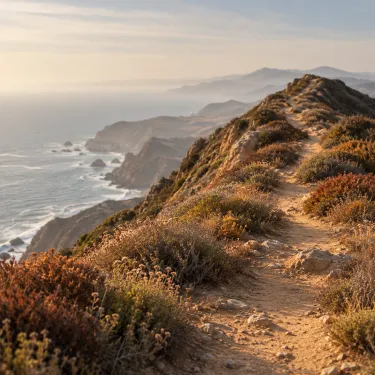
Laguna beach hike sore legs are a particular flavour of sore, and it is the fault of the first ten minutes rather than the last. The trails climbing out of town toward Top of the World go up roughly eight hundred to nine hundred feet, and the distinctive thing about them is that they start climbing from the trailhead. There are barely any switchbacks and there is no gentle approach. You park, you walk twenty yards, and you are going up.
Why a cold start matters this much
Most hikes give you fifteen or twenty minutes of flat before the work begins. That is not a formality — it is when tissue warms, joints start moving through their full range, and your system works out what it is being asked to do.
Here, none of that happens. Calves that were in a car seat four minutes ago are suddenly under sustained load at a steep angle, which is a demand they have not been prepared for. Add that you have probably driven down the coast to get there, so the hips arrive already closed from sitting, and you are climbing with hip flexors that have not opened yet.
That combination — cold tissue, immediate steep load, closed hips — is why people who hike other trails without trouble come back from this one stiff.
What each part of the climb does
Calves and Achilles take the ascent. A steep grade holds the ankle in a demanding position for the entire climb. This is the area people most often feel the next morning.
Hip flexors are asked to work short. Lifting the knee repeatedly on a steep grade, from a starting position that was already shortened by the drive.
Quadriceps take the descent. Braking downhill damages muscle more than climbing does, which is the mechanism explained in Crystal Cove hike recovery, and it peaks around forty-eight hours later.
The lower back takes the lean. A steep climb pitches you forward, and holding that for half an hour is a load whether or not you are carrying a pack.
The things that change the outcome
Walk the flat for ten minutes before you start up. Round the car park, up the road, anywhere. The single most useful thing on this list, and the one nobody does because the trailhead is right there.
Short steps on the way down. More steps, each taking less braking. It is the difference between sore and very sore on Tuesday.
Drink more than feels necessary. The ridges have no shade and no water, and November afternoons here are warmer than they look from a cool morning.
Keep moving at the bottom. Five minutes of flat walking before getting into the car. Stiffening on the drive home undoes a good share of the recovery you would otherwise have had.
The first forty-eight hours
Day of: eat, drink, and do not spend the evening motionless.
Day one: gentle walking. Not stretching, not foam rolling anything that is genuinely sore. Movement through a normal range.
Day two: the worst day, reliably. Stairs are the test. Expect it.
Day three onward: the right window for hands-on work.
What to book, and when
The timing rule is the same for every hard descent: not on the day.
Three days after is the sweet spot. Acute soreness has settled and what is left is stiffness worth addressing. For legs specifically, an hour is enough if you say what you did — the 60-min Deep Tissue Massage at $130 covers calves, quads and hips properly with that brief.
Or the week before a big one. Hips and ankles that already move well change how a steep climb is absorbed, and that is the more useful appointment if you hike often — the case is in sports recovery massage.
If the hips are the real complaint, and after a drive-plus-climb day they often are, assisted stretching reaches them in a way table work does not — see Thai massage for tight hips.
Why driving there makes it worse
Almost everybody arrives by car, and the drive is part of the problem rather than neutral time.
Thirty minutes of sitting closes the hip. You begin a steep climb with hip flexors already at their shortest, being asked immediately to work at that length.
Calves cool and shorten. A foot resting on a pedal at a fixed angle for half an hour is not a neutral position either.
The lower back stiffens. Then takes a forward lean straight away.
The fix is the ten-minute flat walk before you start climbing, and it is the reason that advice is first on the list above rather than last. Five minutes of walking costs nothing and removes most of the cold-start penalty.
One thing worth not ignoring
Ordinary post-hike soreness is symmetrical, dull, worst on day two, and improving by day four. Anything that is sharp, one-sided, in a joint rather than a muscle, or getting worse rather than better after day three is a different thing and is worth having looked at properly rather than massaged.
Everything else is the normal price of a steep trail, and it gets cheaper the more often you pay it.
The studio is about twenty-five minutes up the coast from central Laguna, and the wider version of recovering from a day outdoors here is in after a massage in Newport Beach. Check times and book — and say that it was a steep one with a long way down.