
Thai massage for tight hips: why this one works when stretching does not
Tight hips are the complaint most people have given up on. They stretch, nothing changes, and they conclude they were built this way. Usually the stretching is the problem.
Thai massage for tight hips comes up constantly, and almost always from somebody who has already tried to fix it alone. They have a hip stretch they do most evenings. It has done nothing for a year. The reasonable conclusion is that their hips are simply like this, and that conclusion is nearly always wrong — what is usually wrong is which tissue is being stretched, how long it is held, and whether anything else is holding on at the same time.
What is actually tight
"Tight hips" is four different things wearing one label, and they want different handling.
The hip flexors at the front. Shortened by sitting. These are the ones people almost never reach, because the common stretches target the back of the leg instead. The mechanism is in tight hip flexors from sitting.
The deep rotators at the back. Small muscles under the glutes. Their tightness shows up as an ache in the middle of the buttock and a leg that will not cross comfortably.
The outside of the hip. Tender under pressure, usually worse on one side, and common in runners and cyclists.
The joint itself. Sometimes the limit is not muscle at all. A therapist can feel the difference, and it changes the plan.
Most people have at least two of the four, which is the real reason one stretch does not solve it.
Why the evening stretch is not landing
Three reasons, and the first is the big one.
You are holding it for fifteen seconds. Tissue that has been short for years does not respond in fifteen seconds. It responds to a position held long enough to stop defending, which is well over a minute, and almost nobody holds a stretch that long alone.
You are bracing to stay there. Holding yourself in a lunge recruits half your body. Every one of those contractions limits the stretch you are trying to get.
You are stretching the part that hurts. The sore side is often the overworked one, compensating for a stiff opposite hip. Stretching the complainer does nothing about the cause.
What Thai massage does differently
It removes the first two problems outright and gives the therapist a way to work out the third.
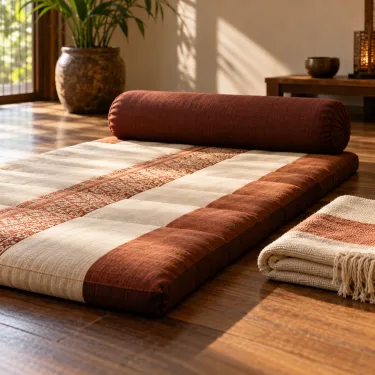
You lie on a mat, fully clothed, and do nothing. The therapist moves your leg through positions you could not hold yourself, keeps them there while you breathe, and presses into the muscle that is resisting at the same time. Pressure and lengthening together, with nothing of yours working. That combination is the whole argument, and it is unpacked in Thai massage stretching explained.
The hip sequence usually covers a figure-four to open the rotators, a single-leg raise for the hamstrings, a lunge-shaped position for the front of the hip, and a twist with the shoulders held down. Each is slow and each is held.
What a session feels like, specifically
The front of the hip is the surprise. People arrive expecting the outside to be worst and find the front is the area that has quietly lost the most.
One side is noticeably worse. Nearly always, and most people cannot predict which until they are on the mat.
The release is not dramatic. Nothing pops. What happens is that the fourth repetition of a position goes further than the first, and you notice it walking to the car.
You may be worked the next day. Mild, in the hamstrings and the front of the hip. It passes by day two, and it is a different thing from the soreness in being sore after a deep tissue massage.
What to book
Sixty minutes is the right first session. The 60-min Traditional Thai Massage at $130 covers legs, hips and back without rushing, and hips are the area that benefits most from the format.
Say "hips" when you arrive, and say which side. It changes the sequence. If you run or ride, say that too — mileage tells a therapist what pattern to expect.
Expect to come back. Years of sitting do not undo in an hour. What one session does is show you how much range is actually available, which is usually more than you thought.
Runners, cyclists and the one-sided hip
Two groups turn up with tight hips more than any other, and the pattern differs between them.
Runners usually have tight hip flexors and hamstrings together, with one side worse. Always running the same loop in the same direction plays a part, as does road camber. The related leg pattern is in massage for runners legs.
Cyclists arrive with the front of the hip genuinely short, because a riding position holds it closed for hours and no phase of the pedal stroke opens it again.
Both tend to have a strong, stiff hip on one side and a mobile, overworked one on the other, and almost everyone guesses the wrong side.
If you train, say the distance and the frequency when you arrive. It changes which hip gets the time.
Keeping it between sessions
Two things, both boring, both effective.
Stand up every half hour. Not a stretch. Standing. The hip flexor shortens because it is held short for hours, and interrupting the hours is worth more than a nightly stretch.
Hold the stretches you do for ninety seconds. If you are going to do them, do them long enough to matter.
The general version of that argument is in what to do between massages.
If your hips have been "just tight" for a couple of years, that is exactly the case this format handles well. Check times and book, and wear something loose enough to be moved around in.