
Crystal Cove hike recovery: it is the way down that hurts
Everyone braces for the climb out of Moro Canyon. The quads that are wrecked two days later were damaged on the descent, and the reason is a different kind of muscle work entirely.
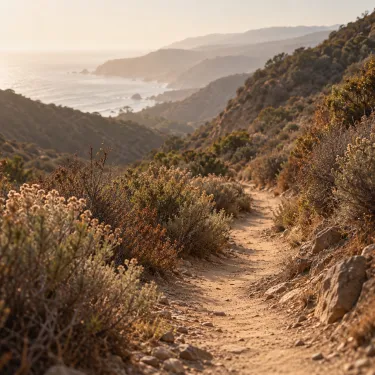
Crystal cove hike sore legs show up about thirty-six hours after you get home, and by then most people have blamed the climb. It was not the climb. The ridge loops out of Moro Canyon put eight hundred feet or more under you and the way up is unmistakably the hard part while you are doing it — lungs, heart rate, stopping to look at the view that you did not really need to look at. But the thing that leaves you unable to sit down on Tuesday is the way back down.
Two completely different jobs
Going up, your quadriceps shorten as they contract. That is the straightforward version of muscle work: it is tiring, it burns, and it recovers quickly.
Going down, the same muscles contract while being lengthened. They are acting as a brake, paying out slowly against your bodyweight plus gravity, thousands of times on a long descent. That kind of loading produces far more microscopic disruption in the muscle than the climb does, and it is the single most reliable way to be properly sore two days later.
Which is why the pattern is so consistent: fine on the day, slightly stiff the next morning, genuinely struggling on day two. That delay is not a mystery and it is explained properly in delayed onset muscle soreness.
Why this trail in particular
Three features of the terrain here make it worse than the elevation number suggests.
The climb is front-loaded. On the canyon routes the steepest part comes early and then the grade eases, which means you descend a long, sustained, moderate slope at the end rather than a short sharp one.
The surface is loose. Dry dirt and gravel over hardpack. Every step down involves a small stabilising correction, and those corrections are taken by the outside of the hip and the small muscles around the ankle.
There is no shade and no water. Dehydrated muscle is more easily damaged and slower to recover, and the canyons here get hot well into November.
Where it lands
Quadriceps, both sides, badly. The signature of a descent. Stairs become the problem, and going down stairs is worse than going up — the same mechanism, in miniature.
Calves and Achilles. From the climb rather than the descent.
The outside of one hip. Usually the side that took the uneven ground.
Lower back. From the pack, and from the forward lean on a long climb.
What to do, in order of when
In the car park: walk for five minutes before you get in the car. Stiffening up on the drive home makes everything worse.
That evening: eat, drink properly, and move around the house rather than settling onto a sofa for four hours.
Next morning: walk, gently, for twenty minutes. Movement through a normal range is the best thing available on day one, and it is more useful than stretching.
Day two: this is when it peaks. Expect it rather than being alarmed by it.
Day three: book something. By now the acute soreness is passing and what remains is worth working on.
What not to do on day one
Do not book a firm massage for the evening of the hike, and do not stretch hard into sore quads.
Tissue that has just taken a long eccentric load is already irritated. Adding deep pressure to it on the same day reliably makes day two worse rather than better, for the reasons in being sore after a deep tissue massage. If you want something on the day itself, keep it light and warm.
What to book, three days later
For the legs, an hour is enough if you name the areas. The 60-min Deep Tissue Massage at $130 covers quads, calves and hips properly when the therapist knows that is the brief.
If you hike regularly, the more useful pattern is a session before the big one rather than after — looser hips and ankles going in change how the descent is absorbed. That is the argument in sports recovery massage.
If it is the hips rather than the quads, the assisted stretching format reaches them differently — see Thai massage for tight hips.
The pack and the lower back
Day packs get blamed for shoulders and are usually a lower-back problem instead.
Weight sitting low pulls you backwards, so you lean forward to compensate, and you hold that lean for the entire climb. The muscles either side of the lumbar spine do that holding.
No hip belt means the shoulders carry everything. Most small packs have one and most people leave it undone.
Water is the heaviest thing you carry, and on a dry canyon trail you start with all of it. The first hour is always the heaviest hour.
Tighten the hip belt, put the heavy items high and close to your back, and the low-back part of the next day largely disappears.
Two things for next time
Shorten your stride on the way down. More, smaller steps means less braking per step. It is the single biggest change available and it costs nothing.
Use poles if the descent is long. They take a genuine share of the load off the quads, and people are far too proud to use them on a trail this accessible.
The studio is roughly twenty minutes up the coast from the park entrance, and the wider version of recovering from a day outdoors here is in after a massage in Newport Beach. Check times and book for the Tuesday, not the Sunday.