
Cupping vs deep tissue massage: one pulls, one pushes
They are often described as alternatives and they are not. They do opposite mechanical things, suit different complaints, and the useful question is which one your problem is.
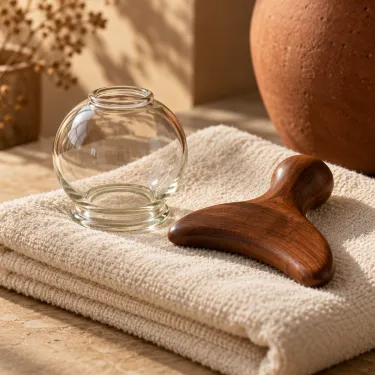
Cupping vs deep tissue massage is usually framed as a choice between two intensities, as though one is the gentler version of the other. That is not the difference. The difference is directional: deep tissue presses tissue down and in, cupping lifts it up and out. Everything else — what each one suits, how it feels, how sore you are afterwards — follows from that one fact, and once you have it the choice becomes obvious.
The mechanical difference
Deep tissue compresses. A thumb, forearm or elbow applies sustained pressure into a specific area, slowly, until the tissue under it stops guarding. It is precise, it is local, and a therapist can feel exactly what is under their hand. What that involves is set out in what deep tissue massage is.
Cupping decompresses. Air is drawn out of a cup placed on oiled skin, so skin and the layer beneath lift into it. It is broad, it reaches the interface between muscle and skin that pressing goes straight through, and it covers ground faster than hands can.
Neither is deeper than the other in any meaningful sense. They address different layers in different directions.
What each one is good at
Deep tissue is better for a specific spot. The knot between your shoulder blade and your spine. The one place in your calf. Anything you can put a finger on.
Cupping is better for a broad, thick area. A whole upper back that feels dense rather than knotted. The fronts of both thighs. Areas where there is no single point to find.
Deep tissue is better when you want change in one place. Sustained pressure on one area for several minutes is how settled tissue actually shifts.
Cupping is better when pressing is off the table. Legs that are too sore for firm work two days after a hard effort still tolerate lifting, which is why it has a place in a training week — see cupping for athletes.
How they feel
Deep tissue is a strong, specific ache that eases while the pressure stays there. That easing is the signal it is working. How much pressure is appropriate is its own question, answered in how much pressure deep tissue massage needs.
Cupping is a pulling, slightly odd sensation that almost nobody describes as painful. The usual word is "strange", followed by "and then quite nice". A static cup feels tight; a gliding one feels like being smoothed in reverse.
Afterwards
Deep tissue can leave you sore for a day or two, particularly if it was firmer than your tissue was ready for. No marks, unless you bruise easily.
Cupping rarely leaves soreness and frequently leaves circular marks for three to seven days. Most people find the area feels looser rather than tender, which is the opposite of what the colour suggests. The detail is in how long cupping marks last.
That is the practical trade: one costs you comfort, the other costs you appearance. Which matters more depends entirely on your week.
Which one for which complaint
A desk shoulder with one bad spot — deep tissue.
A whole upper back that feels like a board — cupping, or both.
Legs two days after a long descent — cupping first, deep tissue later in the week.
Chronic stiffness that has stopped responding — cupping, because novel input is the point.
Something sharp, recent or getting worse — neither. That is a diagnosis, not a massage.
Why the real answer is usually both
They are not competing. The cups handle the broad areas quickly and leave the tissue warm and easier to work; the hands then go into the specific spots that are left. Used in that order they take less time and achieve more than either alone.
That is how it is arranged here. Cupping is not a separate booking — it sits inside the 120-min Deep Tissue Massage at $210, as part of a full deep tissue session rather than instead of one.
If the Thai format suits you better, it is also inside the 120-min Traditional Thai Massage at $260, where it works alongside the assisted stretching instead.
Two things people assume and should not
"Cupping is the gentle option." It is different, not gentler. Strong suction on a tight upper back is a substantial sensation, and plenty of people find a static cup held for several minutes harder to lie still through than firm thumb pressure. What it is not is sharp.
"The marks mean it worked." They do not. How much you mark depends on your skin, the area, how long the cup stayed and how congested the tissue already was. Two people can have identical sessions and walk out looking completely different, and the one with no marks has not been short-changed.
The same logic applies in reverse to deep tissue: being sore the next day is not evidence of a good session, and frequently means the pressure went past the point where anything useful was happening.
How to choose on the day
Do not choose a technique. Describe the problem and let the room decide.
"There is one spot under my right shoulder blade that has been there since August" and "my whole upper back feels thick and I cannot say where" lead to completely different sessions, and neither of them requires you to know the name of a technique. That is the point of what your massage therapist needs to know.
Check times and book, and bring the description rather than the diagnosis.