
Cupping for athletes: what it is good for, and what it is not
The marks turn up on swimmers and sprinters every few years and the internet decides it is magic. The honest version is narrower, more useful, and worth knowing before you book.
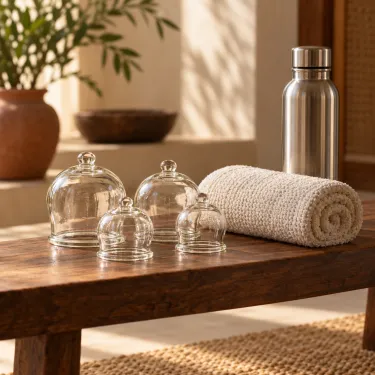
Cupping for athletes gets rediscovered every few years, usually when somebody wins something on television with a row of circles across their shoulders. Then the claims get big, and the useful, ordinary version of what it does gets lost underneath them. It is worth separating the two, because there is a real case for it in a training week — it is just a narrower case than the one being made online.
What it does that pressing does not
Every other technique in a massage compresses tissue. A cup lifts it. Air is drawn out so the skin and the layer underneath rise into the cup rather than being pushed down.
Two consequences follow, and they are the whole mechanical argument.
It works the layer between muscle and skin. That interface is hard to reach by pressing, because pressing takes your hand straight through it into the muscle. Lifting addresses it directly.
It is a different sensation for the nervous system. A body that has had a lot of deep tissue work over a season stops responding to it as much. A pull rather than a push is novel input, and novelty matters more in this than people expect.
The technique in general is covered in what cupping massage is.
Where it earns its place in a training week
Three situations, specifically.
A broad area that feels thick rather than knotted. Upper backs, the fronts of thighs, the big muscles of the hip. Gliding cups cover ground quickly in a way that thumbs cannot sustain.
Tissue that is too sore for firm pressure. Legs two days after a hard descent or a long run often cannot take deep work, for the reasons in delayed onset muscle soreness. Cupping gives you something useful to do with that tissue when pressing is off the table.
Stiffness you have stopped noticing. The chronic, settled kind that has stopped responding to the usual session.
Where it does not help
Being equally clear about this is the point of the article.
It does not remove anything from your body. Not lactate, not waste, not toxins. The marks are blood drawn toward the surface, which is explained in how long cupping marks last.
It is not a treatment for an injury. A strained hamstring, a joint problem or anything that is getting worse week on week needs a diagnosis, not a cup.
It will not make you faster. No recovery modality does, and anyone who tells you otherwise is selling.
It does not replace deep tissue work. Different jobs, it does a different job from pressing, which is why both have a place.
What it does is make a body feel looser and move more freely for a few days. That is a modest, real benefit, and in a hard training block a few days of moving better is worth having.
Timing it around sessions
This is where most people get it wrong.
Not the day before a race or a big session. Novel input plus visible marks plus a slightly unusual feeling in the legs is not what you want twenty-four hours out. Give it three days.
Best in the first half of a recovery week, or two to three days after your hardest session.
Not immediately after a long effort. Tissue that has just been hammered does not need more input that day. Walk, eat, sleep.
Leave five to seven days between cupping sessions on the same area. Long enough for the marks to clear, which is also roughly how long the looser feeling lasts.
What the evidence actually supports
Worth saying plainly, because the gap between the claims and the research is wide.
Studies on cupping for muscle soreness and range of motion are small, short, and hard to blind — it is not possible to give somebody a convincing fake cup. What they tend to show is modest short-term improvement in how people report their own soreness and flexibility, with little evidence of lasting physiological change.
That is a reasonable basis for using it the way it is described here: as something that makes a body feel looser for a few days inside a training block. It is not a basis for claiming it speeds healing, clears anything, or improves performance.
The honest summary: it feels good, it is low-risk for most people, it has a real and limited mechanical rationale, and anyone promising more than that has stopped describing cupping and started selling it.
Who should not have it
Say so before booking rather than on the table: anybody on blood thinners, anybody with a bleeding or clotting disorder, broken or inflamed skin over the area, a recent injury that is still acute, or pregnancy. That list sits alongside everything else in what your massage therapist needs to know.
And a practical one: if you compete in anything where your back or shoulders will be visible within the week, plan around the marks.
What to book
Cupping here is not a standalone appointment. It is part of the 120-min Deep Tissue Massage at $210, where it sits inside a full deep tissue session rather than replacing it — which is the right arrangement for an athlete, because the cups handle the broad areas and the hands handle the specific ones.
Say what you train, how much, and what is sore when you arrive. "I run forty miles a week and my calves have been thick since September" tells a therapist more than any request for a particular technique does.
Check times and book it into a recovery week rather than a hard one.