
How long do cupping marks last, and what are they?
Circular, dark, and alarming the first time you see them in a mirror. What the marks are, how long they stay, and why a darker one does not mean a better session.
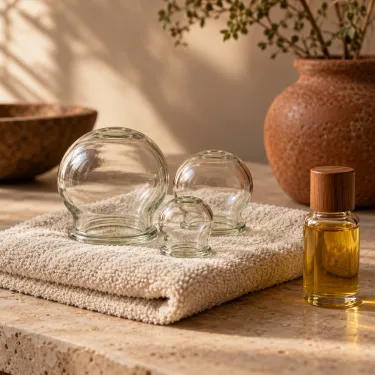
How long do cupping marks last is the question everybody asks afterwards and almost nobody asks before, usually while standing in front of a bathroom mirror looking at a neat row of dark circles across their back. For most people the answer is three to seven days, sometimes up to ten for the darker ones. They fade the way a bruise fades, through purple and brown and then a faint yellow, and then they are gone.
What the marks actually are
Cupping is the one technique in a massage that pulls instead of pushing. A cup is placed on oiled skin and the air inside is drawn out, so the skin and the tissue just underneath lift up into it rather than being pressed down.
That lift draws blood toward the surface in the small vessels under the skin. Some of it stays there when the cup comes off, and that is the mark. It is not an impact injury and it is not damage from force — nothing was struck, nothing was crushed. The colour is simply blood sitting nearer the surface than usual, waiting to be cleared the way the body clears any such thing.
It is worth being plain about what it is not. The marks are not a readout of toxins, waste, or anything being drawn out of you. That claim is common online and there is no mechanism behind it. What is happening is circulatory and local, and that is interesting enough without decoration. The technique itself is covered in what cupping massage is.
Why some people mark more than others
Almost none of it is about how hard the session was.
How long the cup stayed. A cup held in one place for several minutes marks more than one that is glided over oiled skin and kept moving.
How much suction was used. Adjustable, and adjusted to you.
Where on the body. The upper back and shoulders mark readily. Arms and legs usually mark less.
Your own skin. People who bruise easily anyway will mark more here, and that is simply how they are built.
Whether the area was already congested. Tissue that has been tight and worked hard tends to mark more than tissue that has not.
What this adds up to: a darker mark is not a better session. Two people can get the same work and walk out looking completely different.
The timeline, roughly
Immediately: pink to red, often fading noticeably within the hour.
Day one to two: darkest. Purple or deep red. This is normal and expected.
Day three to five: turning brown, edges softening.
Day five to ten: a faint yellow or tan patch, then nothing.
They are not usually sore. Most people report the area feels looser rather than tender, which is the opposite of what the colour suggests, and a different thing from the muscle ache in being sore after a deep tissue massage.
Planning around them
This is the practical part nobody mentions in advance.
Do not have cupping on your back the week of a wedding, a beach holiday or a photoshoot. A fortnight's notice is safer than a week's.
Ask for the moving kind. Gliding cups across oiled tissue marks far less than static cups left in place, and for general tightness it is often the better choice anyway.
Ask for fewer cups, or a different area. Both are reasonable requests, and saying so is the same conversation as telling your therapist the pressure is too much.
Expect to explain yourself at the gym. Everybody does.
When to get one looked at
Routine marks need nothing. Call a doctor if any of these happen instead:
The mark blisters, or the skin breaks. Pain that increases after the first day rather than settling. Marks that have not faded at all after two weeks. Any sign of infection — spreading heat, swelling, or a fever.
None of those are common, and all of them are worth a phone call rather than a search engine.
And one group should skip cupping altogether: anybody taking blood thinners, with a bleeding disorder, or with fragile skin. Say so before booking, alongside everything else in what your massage therapist needs to know.
Why they are not bruises, even though they look like them
The distinction sounds academic and it genuinely changes what you should expect.
A bruise comes from impact. Something struck the tissue, vessels tore, and the area is usually tender to touch for days.
A cupping mark comes from suction. Nothing was struck. Blood was drawn toward the surface by negative pressure and some of it stayed there. The tissue underneath was lifted, not crushed.
Which is why the single most common report afterwards is that the area looks dramatic and feels fine, or better than fine. If a mark is genuinely painful to touch, that is worth mentioning at the next session, because it suggests the suction was stronger than it needed to be.
Where it fits here
Cupping is not a separate booking. It is part of the 120-min Traditional Thai Massage at $260, where it sits alongside the stretching work rather than replacing it.
If you want to know what the combination is like before committing two hours, cupping and Thai massage together covers it. If you already know, check times and book — and tell the therapist if you would rather not be marked this week.