
Back Bay loop run recovery: why the flat one hurts the most
Ten miles with almost no climbing sounds like the easy option. It is the loop that leaves people the stiffest, and the reason is the thing that makes it pleasant.
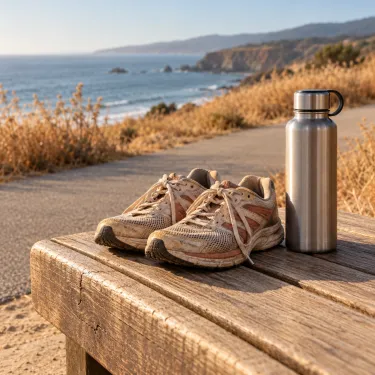
Upper Newport back bay run recovery is not something most people plan for, because the loop does not feel like it needs any. It is flat, it is mostly paved, the view is good and nothing about it is dramatic while you are running it. Then you sit down at a desk the next morning and your calves have turned to wood. The Back Bay is deceptive in a specific and explainable way, and knowing why changes what you do about it.
Why flat and paved is harder on legs
Three mechanisms, and they all point the same direction.
Nothing varies. A hilly route constantly changes which muscles are working and at what length. Flat ground does not. The same fibres do the same job at the same angle for the entire distance, which is a far more monotonous load than it feels like.
There is no walking break. Hills force you to slow down. A flat loop has nothing to force a change of pace, so most people run the whole thing at one effort and finish having never once stopped loading.
Pavement gives nothing back. Every footfall returns the full impact up the chain. On a long flat route that is tens of thousands of identical repetitions through the same tissue.
Add the distance — the full loop runs to something like ten or eleven miles depending on where you join it — and it is a bigger session than it feels like at the time.
Where it lands
The pattern is consistent enough to predict.
Calves and Achilles. First and worst, usually on the second morning rather than the first. This is ordinary post-exercise soreness, and the timing is explained in delayed onset muscle soreness.
Hip flexors. A steady cadence held for ninety minutes shortens the front of the hip, particularly if you then spend the afternoon sitting.
The outside of one knee or hip. Almost always the same side, and that side is usually explained by which way round you run the loop and the camber of the path.
The lower back. Late-run fatigue changes your posture, and the last two miles are run with a different trunk position from the first two.
The hour after you finish
What you do here is worth more than anything you do two days later.
Keep walking for ten minutes. Do not stop at the car. Circling the lot slowly is enough.
Eat and drink something. Both, within the hour.
Do not sit down for long. The single biggest predictor of how stiff you are on Monday is how much of Sunday afternoon you spent in a chair.
Skip the deep stretching. Tissue that has just taken ten miles of repetitive load does not want to be forcibly lengthened. Walk instead.
When to book, and what
The timing matters more than the treatment.
Not the same day. Firm work on legs that ran this morning makes the next two days worse rather than better. The reasoning is in being sore after a deep tissue massage.
Two to three days afterwards is the sweet spot. The acute soreness has passed and what is left is the stiffness actually worth working on.
Or the day before a long one. A lighter session the day before works well, and suits anybody building toward a distance.
For the legs themselves, an hour is enough if you are specific about where. The 60-min Deep Tissue Massage at $130 covers calves, hamstrings and hips properly when you name them on arrival. If the hips are the real story — which for flat-route runners they often are — the assisted stretching format reaches them differently, and that case is made in Thai massage for tight hips.
Why the day after feels fine and the day after that does not
This catches people out every time, and it leads to the wrong conclusion.
You wake up on Sunday a little stiff, decide you got away with it, and go about your day. Monday is worse. Tuesday morning you cannot get down the stairs normally. Nothing has gone wrong — ordinary post-exercise soreness peaks between twenty-four and forty-eight hours, and a flat repetitive route loads tissue in exactly the way that produces it.
What that means practically: do not judge the run by how you feel the next morning, and do not book the massage for then either. The Sunday appointment is the one that gets wasted.
And do not train hard on day two. The temptation after an easy-feeling long run is to go again. Day two is the one to keep gentle.
If you run it often
Three adjustments that cost nothing.
Reverse the direction. Same loop, opposite way. It changes which side takes the camber, and it is the single easiest fix for a one-sided complaint.
Use the dirt where there is dirt. Some stretches have a path alongside the pavement. Softer ground varies the load.
Share it with cyclists properly. It is a busy route in both directions, and the constant small swerves to make room are themselves a load on one hip.
The general version of recovering from a long day outdoors around here is in after a massage in Newport Beach, and the studio is about ten minutes from the north end of the loop. Check times and book for two days after your long run rather than the evening of it.