
Thai massage stretching, explained properly
Half of a Thai massage is somebody else moving your body through positions you cannot hold alone. Why that works better than stretching yourself, and what it actually feels like.
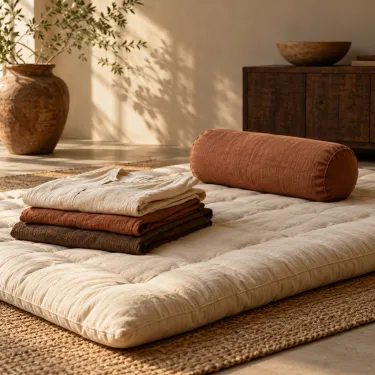
Thai massage stretching is the half of the session people cannot picture before their first one. They can imagine pressure — every massage has pressure. What they cannot imagine is lying fully clothed on a mat while somebody lifts a leg, leans into a hip and holds you in a shape you have never put yourself in. That part is not an add-on. It is roughly half the work, and it is the reason this particular hour changes how people move rather than only how they feel.
Why assisted stretching beats stretching yourself
Three real differences, and they compound.
You can stop working. When you stretch your own hamstring you contract a dozen other muscles to hold the position. Those contractions limit the stretch. With somebody else holding the limb, the muscle being lengthened is the only one with a job.
Someone else finds the end of the range. People stop at the first sensation. A therapist takes the joint to where the tissue actually resists, which is usually further, and holds it there while you breathe.
Pressure and stretch at the same time. A palm stays on the muscle while the limb moves. You cannot do that to yourself, and it is the combination that makes the difference stick.
What it actually feels like
Unfamiliar rather than unpleasant, and almost everybody says the same three things afterwards.
It is slow. Positions are entered gradually and held, not bounced. There is time to breathe into each one.
It is broad. Forearms, palms and feet rather than thumbs. The pressure spreads out, which is why it can be firm without being sharp.
It is interesting. That is the word people land on. A long pull through a hip that has not been opened in a year is a strong sensation, and it reads as satisfying rather than painful. If it tips past that, one sentence fixes it — see does Thai massage hurt.
The positions you will probably meet
Sequences vary, but a first session nearly always includes these.
A single-leg hamstring lift. One leg raised and supported while the other stays down. The most universally strong one, and the one that changes fastest between visits.
A figure-four at the hip. Ankle across the opposite thigh, knee pressed gently out. This is the one desk workers feel most, for the reasons in tight hip flexors from sitting.
A spinal twist. Knees to one side, shoulders staying down. Broad, and usually the one people enjoy most.
Shoulder and arm opening. Arms taken overhead and out, often with a forearm anchoring the shoulder blade.
A seated finish. Many sequences end sitting up, with the therapist opening the chest from behind.
Three things that make it work better
Go floppy. The most common mistake is helping. If you lift your own leg into the stretch you are contracting the muscle being lengthened, and the two cancel out. Let the limb be heavy.
Breathe out as the stretch arrives. This changes the experience more than any adjustment the therapist makes.
Wear clothes you can move in. It is done fully clothed with no oil, which trips people up the first time — the practical version is in what to wear for a Thai massage.
How it differs from a stretching class
People who already do yoga often assume this will be familiar. It is related, and it is not the same thing.
Someone else decides where the end is. In a class you stop where you choose. Here a therapist takes the joint to where the tissue resists, which is usually further, and that gap is most of the benefit.
Pressure is happening at the same time. A palm or forearm stays on the muscle while the limb moves. No class can do that.
Positions are held far longer. A minute or more is normal. In most classes, fifteen seconds is normal.
You do none of the work. Which is the part regular yoga practitioners find hardest and benefit from most.
Who it suits, and who it does not
It suits people who sit all day, anybody whose complaint is stiffness rather than soreness, runners and cyclists with tight hips and hamstrings, and people who have had plenty of table massage and want something that changes range rather than just tension.
It suits less well anybody with an acute injury, recent surgery, or a joint that is already unstable. Say so before you book; it is exactly the sort of thing in what your massage therapist needs to know.
Why it is done on a mat and not a table
The floor is not tradition for its own sake. It is a requirement of the technique.
The therapist needs their body weight above you. Leaning into a stretch from standing or kneeling is how the pressure is generated without strain, and a table puts you at the wrong height for that.
Limbs need somewhere to go. A spinal twist or a wide leg position needs floor space on both sides that a table simply does not have.
You need to be moved around. Side-lying, seated, face up, face down, repeatedly. A mat makes those transitions easy; a narrow table makes them precarious.
The practical consequence is worth knowing in advance: you are getting up off the floor at the end. If that is difficult for you, say so when booking and the session can be adapted.
How long, and what it costs
Sixty minutes is enough to cover legs, hips and back properly. The 60-min Traditional Thai Massage at $130 is the standard first session and the right place to start.
Ninety gives the sequence room to work the shoulders and arms properly as well, and most people who come back a second time book the longer one — which is the general pattern described in how long a massage should be.
The honest expectation for a first session: you will feel taller and looser walking out, slightly worked the next morning in the hips and hamstrings, and noticeably freer on day two. Check times and book, and wear something you could do yoga in.