
What do you wear under the sheet? Massage draping, explained
The question people are too embarrassed to ask, answered plainly: what comes off, what stays on, who sees what, and what the sheet is actually doing.
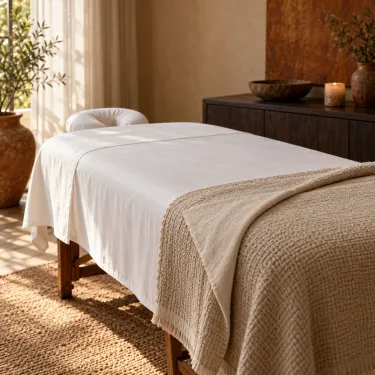
What do you wear under the sheet massage clients are lying under is the question most people want answered before their first appointment and almost nobody asks out loud. It is a completely reasonable thing to want to know, and the vagueness of the usual answer — "undress to your comfort level" — helps nobody who has never done this before. So, plainly: you undress to whatever you choose, you are under a sheet the entire time, and only the part being worked on is uncovered.
What draping actually means
Draping is the professional term for how the sheet and blanket are used, and it is a defined standard rather than a courtesy.
You are covered the whole session. From the moment you are on the table until you sit up at the end.
One area is uncovered at a time. The therapist folds back the sheet from the area being worked, works it, and covers it again before moving on. A back, a leg, an arm — one at a time.
The sheet is tucked, not just laid. When a leg is worked, the sheet is tucked under the other side so nothing shifts.
You undress and dress alone. The therapist leaves the room, knocks before returning, and you are already under the sheet by then.
Glutes and chest stay covered unless specifically discussed and agreed beforehand, and the drape is handled so that neither is exposed when the hip or shoulder is worked.
So what do you actually take off?
Honest answers for each option.
Everything off. What a lot of people do for an oil massage. The sheet handles the rest.
Underwear on. Just as common, equally fine, and genuinely does not restrict the work for most sessions. If the low back or hip is the problem area, the waistband may be adjusted slightly, with the sheet still doing the covering.
Everything on. Right for some treatments. Thai massage is done fully clothed on a mat with no oil at all, which is a different format entirely — see what to wear for a Thai massage.
There is no wrong answer and nobody is making a note. The only thing worth considering is that oil and clothing do not mix, so if you keep something on, keep on something you do not mind getting oil on. The general version of this is in what to wear to a massage.
How a session actually runs
Knowing the sequence removes most of the awkwardness.
You talk through what you want while still dressed. The therapist explains which way to lie — usually face down to start — and then leaves. You undress to whatever you chose, get under the sheet, and settle your face into the cradle. They knock, you say yes, and the session begins.
Halfway through you will be asked to turn over. The therapist holds the sheet up and looks away while you roll; you stay covered throughout. At the end they leave again, you dress, and you come out when you are ready. There is no rush and no part of it requires you to be uncovered in front of anybody.
The whole first-visit sequence is in what to expect at a first massage, including the parts before you reach the table.
The things people worry about and should not
Body hair, skin, scars, weight. A therapist has seen every version of a human body and is thinking about tissue, not appearance.
Falling asleep or snoring. Happens constantly. It is a compliment.
Your stomach making noise. That is your nervous system settling. It is the sound of the session working.
Not knowing where to put your arms. Just say so. You will be positioned.
What is not normal
Draping standards exist for a reason, and knowing them means knowing when something is off. You should never be uncovered in an area that is not being worked. Chest and glutes should not be exposed. Nobody should be asking you to remove the drape, and you should never be asked to do anything you have not agreed to.
If any of that happens, you can end a session at any point, for any reason, without explaining yourself. That is not rudeness; it is the standard, and a professional therapist would want you to.
If you are more comfortable with a specific arrangement
All of these are ordinary requests, made regularly, and none of them need a reason attached.
Staying fully clothed. Possible for several formats, and the whole premise of Thai massage.
Keeping an area out of the session. Feet, stomach, scalp, anywhere. Just name it.
Being told before each new area. "Can you say what you are about to work on?" is a request a therapist will simply follow for the whole hour.
Extra covering. A second blanket, or the sheet kept higher than standard.
Saying any of this at the start costs ten seconds and changes the whole hour. Saying nothing and lying there uncomfortable is the common alternative, and it is the one worth avoiding.
Two things that help on the day
Say what you want covered. "I would rather my feet stayed covered" or "please skip my stomach" are ordinary requests, and they are honoured without discussion.
Arrive with a few minutes to spare. Rushing in from the car park makes the first ten minutes harder than they need to be. If you are coming to this studio for the first time, parking at The Hangers is worth two minutes of reading beforehand.
None of this is complicated once you have done it once. If you have been putting off a first appointment because of the sheet question, that is reason enough to book one. Check times, and say it is your first visit when you arrive.