
What to wear to a massage — and what you take off
The honest answer depends on which treatment you booked: two of them you stay dressed for entirely. Here is what to wear, what draping actually means, and what nobody minds either way.
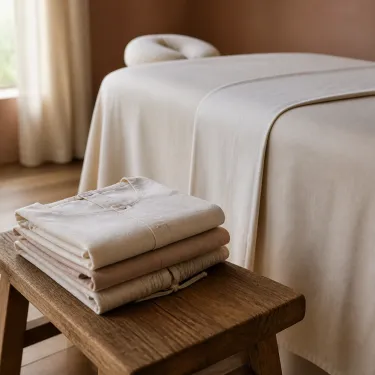
What to wear to a massage has two completely different answers, and which one applies depends entirely on what you booked. For half the menu you stay fully dressed and the clothes you arrive in are the clothes you are worked in. For the other half you undress in the room, alone, and are covered by a sheet the whole time. Neither is complicated once somebody says it plainly, which is what this is.
The treatments you stay dressed for
Thai massage and the foot massage and reflexology session use no oil at all, so you keep your clothes on from start to finish.
For Thai, wear loose clothes you can move in — leggings or soft trousers and a t-shirt. No belt, no stiff waistband, nothing with zips or buckles at the hip, because your legs and spine are going to be moved through stretches and hardware digs in. What to expect at a first Thai massage covers the rest of that hour.
For the foot session, anything you can roll up above the calf. The work goes up into the calves and ankles, not just the feet.
The practical upshot of both: nothing on your skin at the end, no shower to plan around, and you can go straight back to an afternoon. That is what makes the 60-min Traditional Thai Massage at $130 a genuine lunch-break option in a way an oil massage is not.
The oil treatments: undress to your comfort
Swedish, deep tissue, aromatherapy, lymphatic drainage, prenatal and the body scrub all use oil or cream on skin. For these you undress in the room, on your own, and get under the top sheet before the therapist comes back in.
How far you undress is genuinely your call. Most people keep their underwear on. Some do not. Nobody minds either way and nobody is keeping track — the only practical consideration is that oil marks fabric, so anything you keep on may get some on it.
If lower back or glute work is part of what you booked, underwear that sits low or can be moved slightly makes that easier. If that thought is uncomfortable, say so — the work adapts around it and always has.
Draping, explained once
This is the part worth understanding, because it removes most first-time anxiety in one paragraph.
Only the area being worked on is uncovered. Everything else stays under the sheet. When the therapist moves from your back to a leg, the sheet moves with them: folded back over that leg, tucked, and returned before anything else happens. You are never simply lying there uncovered while somebody decides what to do next.
This is not an optional courtesy or a preference to negotiate. It is how the work is done, in every session, for everyone. What happens at a first massage walks through the whole appointment in the same detail.
What to leave at home, or in the car
Jewellery. Necklaces, bracelets, rings and a watch all come off anyway — simpler not to wear them.
Strong scent. Not a rule, a kindness. The room is small, the session is an hour, and if you booked aromatherapy your perfume will argue with the oils that were chosen for you.
Heavy makeup, if you can. Face-down time in a padded cradle is not kind to it.
Contact lenses are fine, though some people prefer to take them out for a session they intend to sleep through.
What to wear out afterwards
The question nobody asks and everybody should. After an oil massage there is oil on your skin, and probably in your hair if the scalp was included.
Bring something you do not mind marking, or wear dark clothes. Better still, book at a time when the next stop is home — and if it has to be the office, book a clothed treatment instead. What to do after a massage makes the case for the evening appointment properly.
Two situations with their own answer
Pregnancy. Prenatal massage is side-lying and supported with pillows. Undressing works the same way; the positioning is what changes. Say how far along you are when you book.
Something you would rather not have seen. A scar, a skin condition, a healing bruise, a tattoo in progress. Mention it at the start — not for modesty's sake but because the work should avoid or adapt around it, and a therapist who does not know cannot.
Glasses, hair and the small stuff
Glasses come off for anything face-down and live on the side table. Contacts are fine, though people who intend to sleep through the session often prefer them out.
Long hair is easier tied loosely rather than in a hard bun — a knot at the back of the head is uncomfortable once your face is in the cradle, and it gets in the way if the session includes the neck or scalp. A soft tie or nothing at all works better than a clip.
Socks stay on or come off, whichever you prefer, unless the session includes the feet.
Arriving from the gym is common and nobody minds. If you would rather freshen up, allow an extra ten minutes rather than arriving at a run.
The other thing people are too polite to ask about is money — whether you tip a massage therapist, and what to do when you would rather not.
The short version
Thai or foot and reflexology → loose clothes you can move in, no belt. Nothing comes off.
Any oil treatment → undress to your comfort level in the room, under the sheet, underwear on or off, and you stay covered apart from the area being worked.
Either way → no jewellery, no strong scent, and something you do not mind oil on if you booked one of the second group.
If you are still deciding which treatment to book at all, which massage to get takes a minute, and the full list with prices is here. Then book a session and wear whatever gets you there comfortably — that part genuinely does not matter.