
What to expect from a hot stone massage, start to finish
The stones are not laid on you and left there. They are worked, and knowing how the hour is actually shaped is the difference between enjoying it and spending it wondering what happens next.
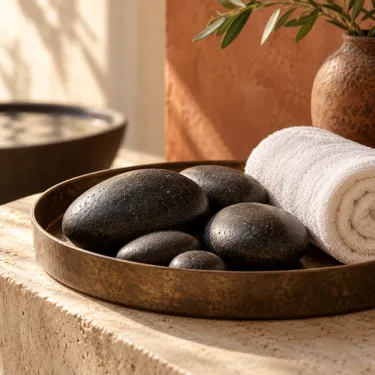
Knowing what to expect hot stone massage sessions involve clears up the one thing nearly everybody has wrong. The picture people carry is a row of stones balanced down a back while somebody leaves the room. That is a photograph, not a treatment. In a real session the stones are held and moved — they are the tool, used in place of a hand for long stretches of the hour, and the warmth is doing a job rather than decorating one.
How the hour is actually shaped
Sequences differ, but the frame is consistent.
It opens with hands, not stones. Warm oil, broad strokes, a few minutes of ordinary work to warm the surface and let the therapist feel what is there.
The stones arrive gradually. A warmed stone is introduced flat against the back, usually at the lower back or between the shoulder blades, and held still for a few seconds so you can register the temperature before anything moves.
They are then used like a palm. Long gliding strokes with oil, the stone held in the therapist's hand. This is most of the session, and it is the part people do not anticipate.
Some are placed and left. Usually along either side of the spine or in the palms, as a background warmth while the therapist works elsewhere with their hands.
Cooling stones are swapped out. A stone that has given up its heat stops being useful. Expect a quiet rotation through the hour.
It finishes with hands. The stones go away before the end.
What the heat is actually doing
Nothing mysterious, and worth being precise about.
Warm tissue is easier to work. Muscle that has been heated takes pressure more readily and with less resistance, so a therapist can reach the same depth with less force. That is the main argument for the whole format.
It reaches a little further than a hand. Heat moves through tissue after the stone has moved on, so the effect lingers behind the stroke.
It makes people stop bracing. Warmth is an unusually effective signal to a nervous system that has been running hot, which is why people who struggle to relax on a table often do better with this one.
What it does not do is remove anything from the body. Any description along those lines is marketing, not mechanism.
How hot, honestly
Hot enough to be clearly warm, never hot enough to be alarming. A stone is tested on the therapist's own skin before it reaches yours, and the first contact is deliberately brief for that reason.
If one is too warm for you, say so straight away — it is swapped in seconds. That conversation is the same one described in how to tell your therapist the pressure is too much, and it applies to temperature exactly as it does to pressure.
Who it suits
People who are always cold. The ones who need an extra blanket on a normal table get more from this than anybody.
People who find deep work too much. Heat does some of what pressure would otherwise have to, so the session can be effective without being intense. If firm work has put you off before, this is the honest alternative, and the comparison is in hot stone versus Swedish massage.
Winter stiffness. Cold mornings and a cold office make everything tighter, and warmth addresses that directly.
Who should skip it
Say any of these before you book rather than on the table.
Reduced sensation. If you cannot reliably feel heat on your skin — including from nerve-related conditions or diabetes — you cannot judge temperature, and that is the whole safety mechanism.
Pregnancy. Ask your doctor first. There is a prenatal option designed for it instead.
Skin that is broken, burnt or inflamed, or very recent sunburn.
You simply dislike being hot. A perfectly good reason, and no therapist will argue.
The full list of what to mention before any session is in what your massage therapist needs to know.
What the first ten minutes tell you
If you have not had one before, these are the markers of a session being run properly.
The stone is tested before it touches you. On the therapist first, every time.
The first contact is brief. Laid flat, lifted, returned. That pause exists so you can object.
Nothing sits directly on bare spine or bone. Stones go either side of the spine, on muscle.
There is a towel layer where one is needed, particularly for anything left in place.
You are asked. Once near the start, and usually again when a new area begins.
If none of that happens, say something. The format is safe because of the system around it, not because the stones are harmless.
What to book
Hot stone here is not a separate line on the menu — it is the premise of the 120-min Swedish Massage at $270, which runs organic oils first and then heated stones. Two hours sounds long until you have had it; the heat only starts doing its real work once everything is warm, and an hour is mostly warm-up.
If you want the background on the technique before committing, start with what hot stone massage is.
Practical notes: the oil means you will want a shower afterwards, you will be warm for an hour or two, and a glass of water on the way out is a good idea. Check times and book — and if you run cold, say so when you arrive.